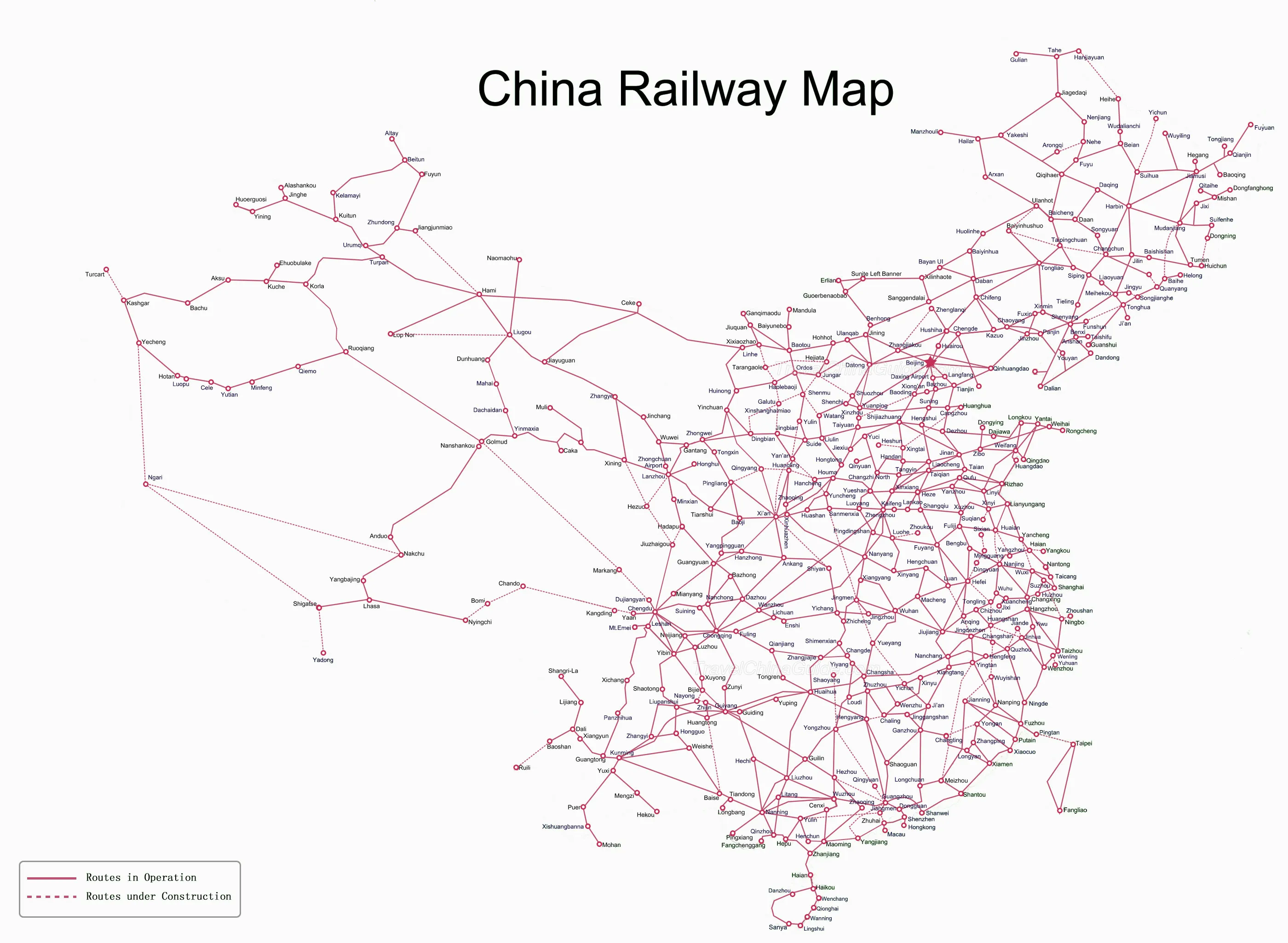
US rail is so pathetic. Not the rail’s fault per se, but it's pretty embarrassing for a a supposedly wealthy country to not be able to offer its citizens cheap, easy, high speed travel across the country.
We do have cheap easy high speed travel across the country. It's just not rail.
In the US, rail is for freight. In the US, cross country distances are too large for terrestrial transport to be high speed. A flight network allows for much better speed, without needing to have continuous infrastructure.
Rail in general requires pretty specific alignment and limits on turns and slope; high speed rail has even tighter tolerances. It's very expensive to build that, especially through rocky terrain, and through existing development.
Flight networks are much more flexible. If you have room for an airport, and demand, you can get direct flights to/from anywhere. Roads are good too; because of their utility, they have a large network which tends to offer better routing than rail, and piecemeal upgades work for roads; switching routes is much easier for cars than trains, and roads can be quite rough but still usable at low speeds.
Yes, China is about the same size as the US, but a route from Beijing to Kashgar is 23k feet up and 21 k feet down. A route from Washington DC to Los Angeles is about the same distance, but has 77k feet up and 77k feet down. A lot more elevation to work through. Much of the east side of that map is relatively flat. And there are bottlenecks getting to the west side, as there would be in the US, but the US has a lot more relative population on the west side than in China.
I'm sure that rail wins over flights in terms of efficiency for passenger miles traveled. However, you often have to travel more miles to get to your destination. A direct flight can save a whole lot of time. Flights are much faster, although security theater adds a lot of time[1]; but for longer routes, or routes with many stops or connections for rail, the single segment operation of a flight starts to win.
Also, China has the advantage of authoritarianism which allows it to more easily get right of way that's well aligned for HSR. While it was once easy to get land for railroads, when there were active land grants, now you'd need to do a lot of work to get well aligned land to add a rail line; where they're still active, existing rail right of ways through developed areas are fine enough for slower service, but expanding the right of way to better align the tracks is a lot of work. In theory, you could eminent domain, but that process is long and expensive.
[1] In a world where you think it's possible to have government intervene to expand passenger rail in the US, it's equally possible to have government intervene to streamline the security theater in flights; or they might add the same security theater to passenger rail.
The area in question (Northeast) is about the only place in the US that matches the population density of the parts of Europe served by high-speed rail.
It's not a question of wealth but of efficiency. Even if you took every single meter of high speed rail that France has built in the last 50 years, you would barely cover 2/3 of the distance of a single line between New York and LA.
New York to LA would be a terrible high-speed rail route. Just way too far. But the US has many city pairs - SF and LA, LA and Vegas, Denver and Salt Lake, Chicago and Detroit, Pittsburgh and Philly, and so on - where high-speed rail could easily replace most flights if it were built.
Some of those routes sound nice, but they don't usually have enough daily traffic between them to warrant the massive infrastructure costs. LA to Vegas would rival the distance of the longest European high speed lines, but with many fewer stops between and a fraction of the passengers between. Outside of connector flights, I don't even know how many people even regularly travel between Chicago and Detroit.
Part of the advantage places like Japan and Europe have over the US is not just that they are dense, but that their population skews to one massive metropolitan center. So it's easy to design a hub model where traffic patterns are easy - in and out of one area. You see this in the success of regional commuter rail networks in the US.
(SF and LA is a great candidate though, and it's failure a highlight of how hard it is to build in the US)
> LA to Vegas would rival the distance of the longest European high speed lines, but with many fewer stops between and a fraction of the passengers between.
Many fewer stops: that's a good thing. A fraction of the passengers? No, that's absolutely false. Brightline estimates 50 million trips between LA and Vegas every year [1], which is more than, for example, the total number of tourists to Paris every year.
> their population skews to one massive metropolitan center
Japan, sure, being a long and skinny group of islands definitely helps. But is that actually true of Europe? Germany has a great high-speed rail network (current on-time performance issues aside) with a very pluricentric population.
So this puts it at pretty low ridership and much higher ticket prices than equivalent lines around the world. (I'm very supportive of the project! It's just worth being realistic about the economics here.
My understanding of Germany's high speed network is that it is pretty comparable to the Acela - high speed in certain corridors, reasonably affordable, and dense population along the corridors. Which is pretty realistic goal for parts of the US. But often we compare to France's network which really outperforms nearly every other country outside of Japan.
With an average speed of 70 mph, the Brightline isn't high-speed as it would be defined elsewhere in the world. Neither is the Amtrak Acela, for that matter.
Yes, US rail is pathetic, at least for passenger travel. However, a quick search on Google Flights shows a one-way ticket from LA to DC costs $98.00 on Frontier via Atlanta (YMMV) so I don't think it's correct to say there isn't cheap, easy, high speed travel across the country.
It's also worth pointing out that even at TGV speeds, a coast-to-coast train ride would take ~20 hours. It would have to be sooo much cheaper than an equivalent plane ticket to be worth it.
If we price the extra travel time at the level of US minimum wage, $7.25/hr, the extra ~15 hours of travel alone would add up to a price tag of $100. And if you don't have a bullet train, then the time-economy gets even worse.
That sure seems like it explains a lot about the state of US passenger rail.
Which makes the train considerably less passenger-dense, and thus makes the train tickets more expensive. In return for reduced value hours: hours that aren't as productive as real office hours, or as entertaining as real vacation hours.
I'm not sure if this would be enough to make coast to coast passenger trains more viable.
What serious person is pitching LA -> DC as a city pair for HSR?
The best routes are the ones that replace short-haul flights that are currently really inconvenient in terms of driving and rail service. A route like New York to Toronto would make plenty of sense, where you have two major population centers that are very close together, but a huge headache to travel between by rail today (at 12+ hours total on Amtrak and Via Rail).
NY to Toronto actually doesn't make sense because there is a border. I took that train ride and it took 2 hours to clear the border. Even today the guideline is 90 mins - 2 hours. The whole trip took 15 hours. Never again.
I could have flown it in less than 2 hours, security included. The flight would have cost less too!
The only way it would work is PreClearance on both sides (but then again, Canada has never been interested in staffing PreClearance in the US, even though they had reciprocal rights to do it). They only started their first one this year in rural NY.
It's only cheap and easy if you discount omnipresent traffic jams, 50,000 deaths per year, ever-worsening climate change and the inability to walk/bike anywhere anymore.
Aside from that, it only costs the average American $1,000/mo to keep that cheap and easy transportation!
Ignoring the point that climate sensitivity wasn't in the parent comment, AFAIK, airplanes generate 0.16 kg/km, whereas trains are around 0.1 kg/km and container ships are at 0.016 kg/km. However, passenger ships and gas cars are at 0.25, diesel cars at 0.28 kg/km and rockets are over 1.0 kg/km, so it appears planes are in the middle, not really "one of the best ways" to worsen climate change.
Sure, through a simple analysis of CO2 kg/km, trains are better for the climate for long distance travel, but they are vastly slower (average time from LA to DC is over 80 hours), which has knock-on effects, e.g., sleeping at home averages 0.25 - 0.32 kg/night, whereas staying at a hotel averages 10-40 kg/night, eating at home averages 2.3 kg/meal vs. 3-8 kg/meal, etc.
Trains are just the most efficient way of moving people between cities. They benefit everyone, even people with cars.
You have a business trip and need to go from A to B by yourself? Take a train, it frees your brain and the highway for people traveling in groups or with lots of luggage.
Incidentally it also avoids moving 2 tonnes of material for no reason.
A passenger train in the USA weighs about 1000 tons, plus another 150 or so tons of locomotive, before we add the passengers (seating 80 per car and about 11 cars for 880 passengers).
One of the most recent inter-city routes to open, the Borealis service between Chicago and St. Paul, far surpassed expected ridership levels in its first year servicing 212K passengers over a projected 155K [1]. This comes despite the fact the trip would be faster not only by air but also by car. I doubt we'd see this sort of overperformance if "most people don't want trains".
Most places where people want trains have them (high density places).
This doesn't address OP's comments. To remind you, they mentioned "cheap, easy, high speed travel across the country". I would grant Amtrak is easy. It's not the other things though...
I'll take the Acela over flying any day. It's cheaper and less of a hassle. Time-to-commute is a wash when you do the airport security theater dance + delayed flights on the tarmac.
We still have the world's largest rail network [1]. It's just focussed on freight. (We also have world-class municipal and regional rail in the New York area.)
I wonder what the cost would be to build a passenger rail network that simply parallels the freight network, even if low speed. Amtrak is terrible mostly because freight trains get priority and it screws up the schedules.
> (We also have world-class municipal and regional rail in the New York area.)
If by world-class you mean something that most of the world would consider a rail system, yes (in comparison to most US cities' attempts which aren't really worth even pretending constitutes regional rail). If you mean something that most of the world would consider as something worth emulating, nope.
The rivers are to good as mass good transport medium. They make goods transport bx rail economically unviable for the core country, leaving only a ring of economic routes.
That is weird thing to say when US has the best freight rail in the world. Lots of containers are transported by rail from west coast to east coast ports. The competition is trucks, not barge.
If anything, that is one reason that passenger rail sucks because the freight companies own the rails. They delay passenger trains and don’t get punished. The freight companies don’t spend on maintenance, and have pulled up double track.
I've found that looking at USA as a middle-income country with extremely wealthy regions helps me better understand our country. The supposed wealth doesn't seem relevant in the hollowed out towns between the coasts. It's generally not being sent or spent there in any meaningful way.
Much of the actual wealth is in the northeast corridor, where the Acela is improving the quality of their product, and in California, where Southern CA and the Bay Area both have fairly nice regional trains that go as fast as the right of way will let them. I think we've done OK connecting places that matter, and as flying continues to enshittify and people will choose rail for comfort.