I think there is a third option, factor in the externalities and treat it as a luxury. The cost we are paying for it is not currently reflected on the final price.
My grandparents and great grandparents in Greece used meat as a garnish a few times per week for dinner. The most meat they would have was at the end of the Lenten fast on Easter where they would have a big piece of lamb. Otherwise, it was the occasional smaller pieces of ground meat on top of vegetable-heavy dishes.
Putting such absolute choices in front of people basically never works. Those conductive to such and argument have already become vegetarian.
But there's a much bigger percentage of people that would be willing to eat meat less, without fully stopping. Turn meat into a delicacy you indulge in, not the default base to prepare every meal on. Try some indian food, or stuff from other cuisines that rely less on meat. Make that twice a week, you'll probably enjoy it, maybe even save some money.
Sure it's absurd to imagine that people make 0/1 choices, however it's also absurd to reject a 3-line shortened proposition because it seems absolute.
> Those conductive to such and argument have already become vegetarian
Choices are more complicated than "being conductive", for exemple
- opinion change: you're not totally against the idea but not convinced neither. If you're open minded, learning something new or being witness of a context change can make you reevaluate.
- Motivation: there's thinks in your life that occupy your brain and you don't feel free to start another change now, but you might being more disponible to self-actualisation later.
- Event-Trigger: An inspiring talk, movie, or discussion with a friend sometimes trigger you to reconsider your position. I know cold showers aren't that hard and they're great for the body and the mind. I never had to courage to start that new habits but a convincing and motivating HN post might be the trigger to a routine.
> Putting such absolute choices in front of people basically never works.
Indeed. Faced with that absolute choice, I'd pick eating meat and dismiss the entire line of reasoning about meat.
And quite frankly I wouldn't even feel guilty about it: I'm pretty sure I'm already doing more than the average to lower my emissions. As a trivial example: I pretty much use public transport all the time and don't have a car. This alone probably puts me above the average american vegan driving an SUV to go from their suburbs to anywhere, in terms of carbon footprint reduction.
Try "Meatless Monday" is a much more effective message than animal welfare, since it offers a reasonable path that doesn't require changing everything all at once, and doesn't tie your past actions to guilt.
People are highly motivated to push back against animal welfare arguments because it makes them feel like bad people. "You can easily make things better by just abstaining once a week" doesn't challenge their identities nearly as much.
  But even when the authors excluded embedded emissions from sources like transport and packaging, they still found that agriculture generated 24% of GHGs. According to the World Resources Institute, a research group, cars, trains, ships and planes produce a total of 16%.

  It finds that animal-based foods account for 57% of agricultural GHGs, versus 29% for food from plants. Beef and cow’s milk alone made up 34%. Combined with the earlier study’s results, this implies that cattle produce 12% of GHG emissions.
It also implies, by the accounting practices of these papers, that clean skins running feral in Northern Australia account for zero emmisions .. particularly if traditionally mustered.
They aren't fed farmed food, they forage and run wild in the Kimberley and Kakadu, and the environment is well served by routinely rounding them up for dinner and taking pressure from the grasslands.
More or less the same story for camels and wild donkeys.
> Surely chicken in your backyard can be kept without CO2 impacts with some effort.
I’m not sure this is possible, at least not in a typical yard or urban garden. According to one study[1] community gardens in and around cities emit six times the CO2 per serving compared to industrial agriculture. I assume this is roughly applicable to backyard gardens too. I wouldn’t be surprised if this isn’t applicable to livestock—which the study appears to have excluded—but also wouldn’t be surprised if the story is similar with chickens/livestock.
I imagine that even if it is less efficient to grow your chickens in the back yard, it might be possible to approach or exceed current industrial poultry farms in CO2 efficiency. My hunch is that if those farms get incentivized by penalties on CO2 production it would be impossible though.
Does that seem likely to make a difference? The study covered individual gardens as well. The low-tech gardening practices they mention sound exactly like backyard gardens.
Of course. The whole study is about cities, even the first sentences already make this very clear. It has nothing to do with normal gardens, nothing _at all_.
I may have missed the part in the paper which explains why a backyard garden is dramatically different in efficiency if said backyard is in a city versus the suburbs. Could you clarify or point me to the thing you’re referring to?
> - health risks can be minimal depending on the amount and type of meat you eat
Health risks from meat is an US-only issue. Here in Europe we have much stricter regulations on meat, so much so that American meat cannot be imported and cannot be sold here. IIRC (might be wrong on this) Canada doesn't allow importing US meat as well?
A while back, the EU relaxed restrictions on feeding animals to other animals in order to boost trade. Restrictions that were in place for good reason after the BSE crisis.
No. It generally doesn't matter where in the world cows are raised, the important point is the conditions. The health risks cannot be minimized because of antibiotic abuse (antibiotic "superbug" evolution) and pandemic virus evolution of cramming too many animals near people who care for them and wildlife.
> mass unethical treatment (assuming you do not mean the fact that animals are killed) is related to the conditions which are related to price
Source? I really don't buy that more expensive meat producers kill their animals that much more "humanely". And even if the killing was painless, you're still killing tens of animals per year for the sole sake of a tastier meal.
> health risks can be minimal depending on the amount and type of meat you eat
True.
> the CO2 impact again depends on the meat and conditions. Surely chicken in your backyard can be kept without CO2 impacts with some effort.
I trust you raise all the animals you eat, and don't feed them with imported grains? Don't be ridiculous.
> your very existence has a CO2 impact. By your own logic you have two choices …
You're basically telling anyone who's self-conscious about their environmental impact to kill themselves. Great.
I believe there's a good argument to be made, yes. This video [0] by a philosophy teacher convinced me of it. Unfortunately, it's in french so most here probably won't be able to enjoy it.
These come up every now and then, but are explicitly arguing against factory farming, not meat consumption in general. Factory farming is indeed immoral, but is a separate, but related issue to meat consumption.
philosophical viewpoint arguing that human beings are the central or most significant entities in the world. This is a basic belief embedded in many Western religions and philosophies. Anthropocentrism regards humans as separate from and superior to nature and holds that human life has intrinsic value while other entities (including animals, plants, mineral resources, and so on) are resources that may justifiably be exploited for the benefit of humankind.
It's hard to argue that we're not in some way unique when we're the only animals having this debate, and every other carnivore or omnivore (and many 'herbivores,' opportunistically) have no such qualms and happily eat all the other animals they possibly can.
- Pandemic virus evolution of viruses from complex people<->livestock<->wildlife interactions.
- Evolving antibiotic resistant bacteria since livestock are given most of the same compounds given to humans simply for economic advantage, and in some cases, to force-feed animals with unsuitable feed like too much corn in too short of a timeframe. Some CAFO farms, their cows would die if not given antibiotics. [0]
- Water, air, and soil pollution on a large scale. Liquid shit lakes that spread manure into the air with sprayers. Runoff from pesticides and fertilizer used to grow the corn, soybeans, etc. The list goes on.
And, yes, climate change, animal cruelty, and other concerns.. but like condoning genocides, nothing will be done about it because people want their fucking Costco-sized 40 pack of cheap hamburgers, BMW SUVs, and overwatered perfectly green grass and air conditioning set to 68 F / 20 C in Phoenix AZ.
This comment is the opposite of nuance. They literally argued that everything you do has a CO2 impact, therefore you either shouldn't try at all or should just kill yourself.
That's, like, the least nuanced and most caveman-brained take on climate change you could possibly develop.
Also: appealing to edge-cases as a distraction isn't nuance, it's derailing. I can find fucking exceptions to anything. ANYTHING. How many people in the West are growing their own chickens? Give me a fucking break man.
I‘m trying to find something resembling a reasoned argument in your comment, but there‘s nothing except profanity.
I did not point out exceptions and the chicken example is merely an illustration of one of my points.
And who says we are talking about the west? Plenty of comments in this thread are talking about pandemics, something that is not known to originate from western agriculture.
You know what‘s a caveman take? Thinking that there is any chance to convince a meaningful number of people to reduce meat consumption globally in the required time window (20-50 years) in a way that has any bearing on climate change (as opposed to the many steps being taken that actually work). That‘s a caveman take.
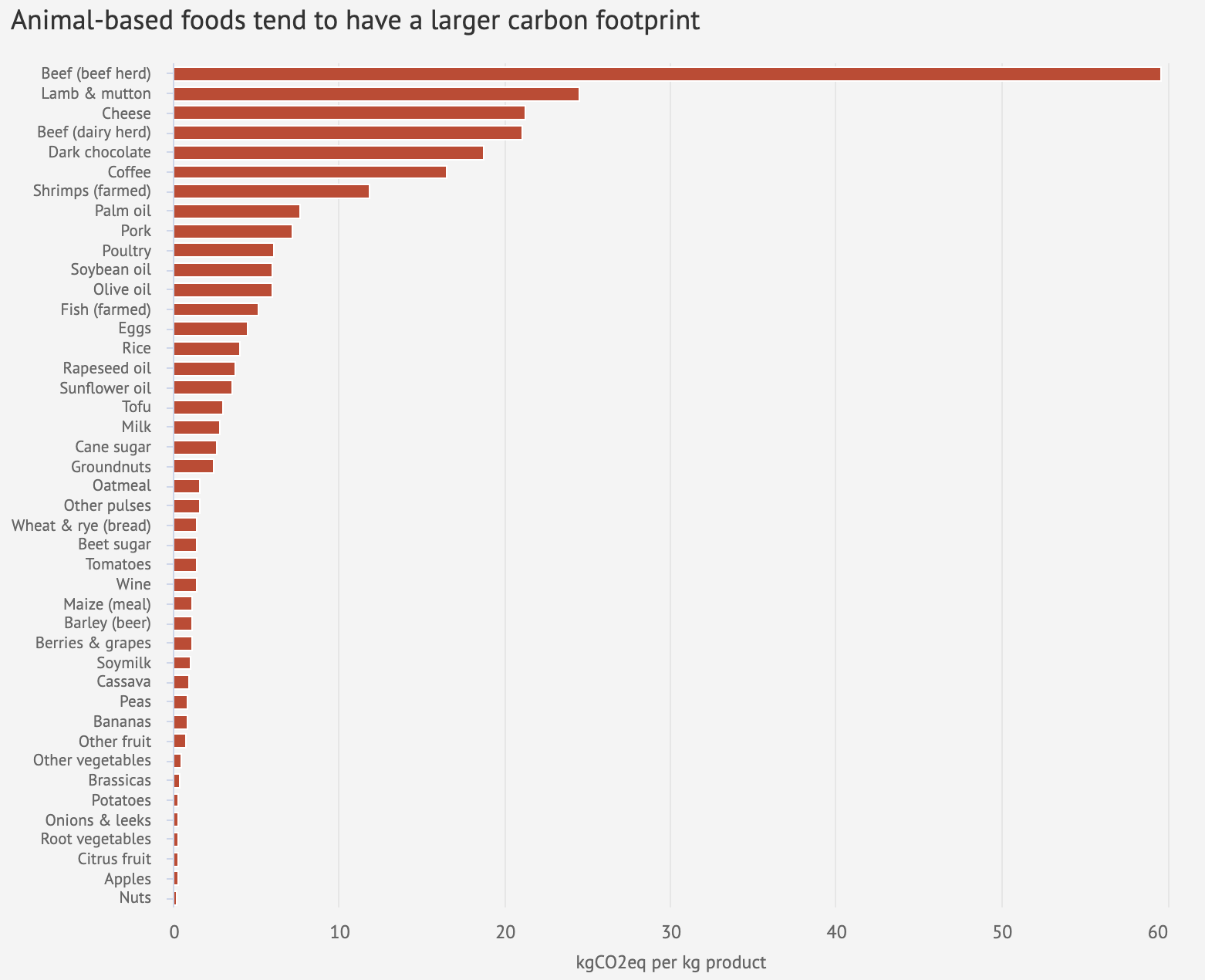
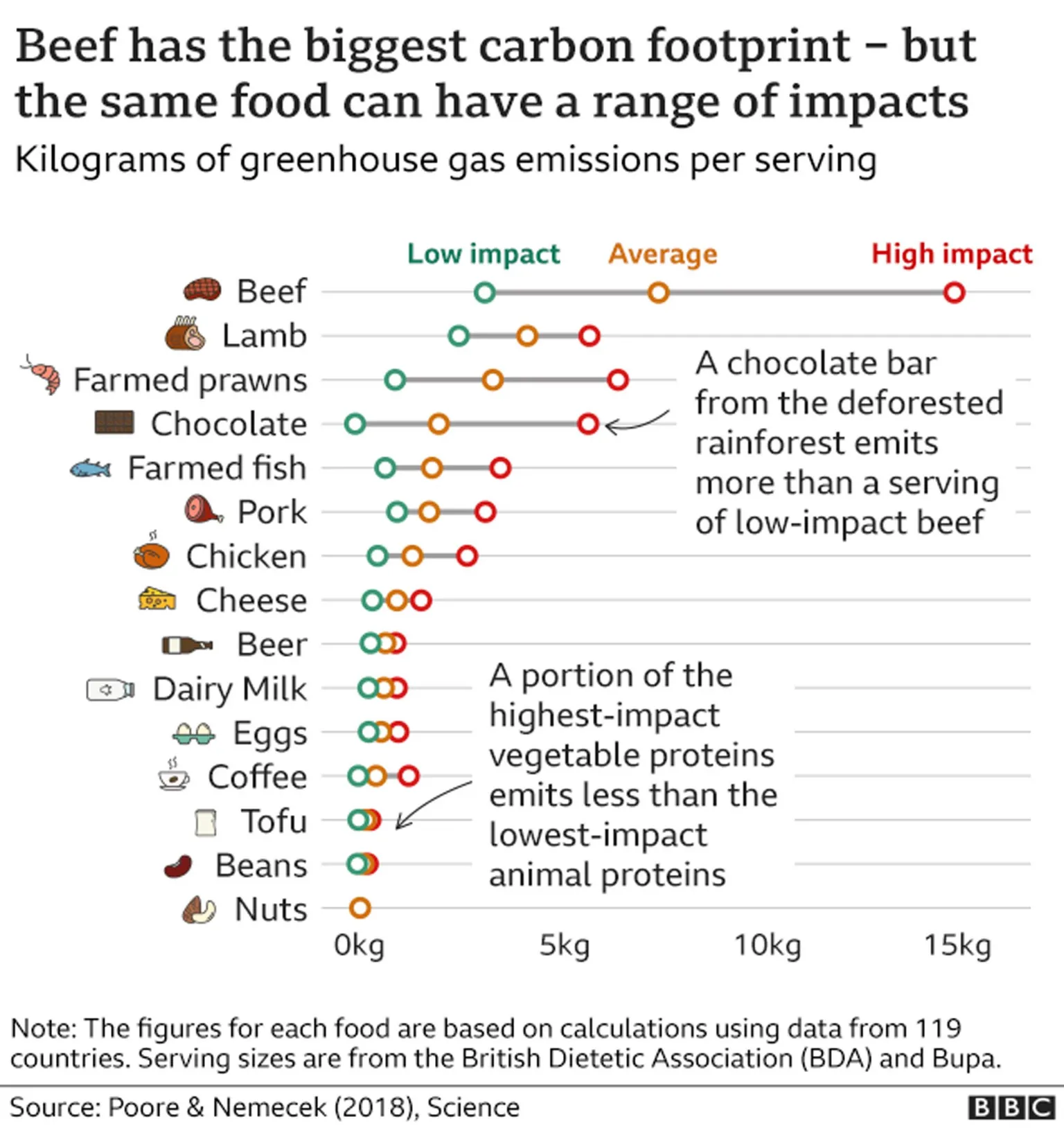
As you can see, the type of meat matters a lot. Cheese is doing worse than pork in this example (not sure I even believe this without more evidence yet). Non-meat sources of protein don‘t do very well: Tofu is just 2x better than poultry. Compare this to the giant bar for beef.
In short, yes, it would be theoretically possible to eliminate about 10% of global emissions if everyone everywhere stopped eating meat and replaced it with a balanced non-meat diet.
But such an outcome is not realistic.
This is my last comment on HN. It is sad what this corner of the internet has become.
> You know what‘s a caveman take? Thinking that there is any chance to convince a meaningful number of people to reduce meat consumption globally in the required time window
The "caveman take" I'm referring to is when you implied the correct solution to climate change is suicide.
It's a caveman take because I've heard it numerous times, and it lacks all nuance or thought. Yes, we emit CO2 by existing the way we do. We can improve our situation without going to extremes. This is a "perfect is the enemy of good" type thought process.
It's what I call an anti-solution. It doesn't solve anything, but it does completely halt the conversation and makes sure that other real solutions can't pop up.
> As you can see, the type of meat matters a lot. Cheese is doing worse than pork in this example (not sure I even believe this without more evidence yet). Non-meat sources of protein don‘t do very well: Tofu is just 2x better than poultry. Compare this to the giant bar for beef.
Okay, but none of this was in your original comment. You talked about raising chickens, which I appropriately clocked as a not real solution that isn't going to work.
Eating more chicken and less beef is good, I agree, and a reasonable solution. You should probably lead with that.


- eat meat, and accept the impact to the environment, health risks, and mass unethical treatment of livestock
- stop eating meat, and accept that some of the foods you grew up eating, you can't eat any more