There is a quality about TBMs which vaguely reminds me of the feeling of getting a new LEGO set and building stuff. Imagine if we had cheap ways to build tunnels, no more traffic, no more congestion, roads and parking lots would only exist underground and cities would have more space for gardens, parks, buildings, and walkways. We have these things - Subways but its very expensive to build that system. Elon has an itch to solve this problem and I want this dream to succeed! While that's going on, please someone make a game out of building tunnels, it would be super cool!
> Imagine if we had cheap ways to build tunnels, no more
> traffic, no more congestion, roads and parking lots would
> only exist underground and cities would have more space
> for gardens, parks, buildings, and walkways.
Or, skip the tunnel building and just ban cars from major cities.
Building more infrastructure to "reduce traffic" only makes using vehicles more attractive. The amount of congestion is approximately equal to the amount of congestion the average person using the infrastructure is willing to accept, so making it less congested just means more people use the infrastructure until the limit is reached again.
The real answer to the problem is to simply ban all but buses and delivery vehicles - even then you can incentivize that they are electrically driven. Space increases and infrastructure maintenance costs are reduced, not increased.
The real golden use for TBMs is for efficiency - i.e. Go around some mountain or go straight through it? Go around a city or go under it? I imagine buildings sharing a service elevator down to the tunnel where delivery vehicles can offload to and send goods up (rather than Musk's idea of trying to lift a several tonne vehicle in some personal elevator).
Would likely make sense for all kinds of maintenance this way to, servicing water/gas pipes or electricity/internet lines for example could be as simple as removing a service panel from the side of a tunnel, rather than the terrible solution we have today involving digging up streets over and over.
Why have technical innovation at all, let's just outlaw stuff...
I really don't get this desire to outlaw cars. I like walkable cities, but I also like the comfort and privacy of car transport. I live in a place (Germany) with good public transport. I used to live in cities with very good public transport. I still don't enjoy being squeezed in with thousands of other people. Does that mean that people like me have to be reeducated and/or forced to see the error of their ways?
> Why have technical innovation at all, let's just outlaw
> stuff...
> I really don't get this desire to outlaw cars.
That's not the point, it's that in this case the infrastructure cost to clean up cities is astronomical. Forgetting air pollution, noise pollution, deaths from traffic collisions, congestion - you also have to consider the shear infrastructural costs that _already_ go into maintaining road surfaces, traffic control, policing, etc. And that's without tunnel boring.
> I like walkable cities, but I also like the comfort and
> privacy of car transport.
I think we just have to look at the practicality of private transport in cities.
> I still don't enjoy being squeezed in with thousands of
> other people.
Perhaps this is where public transportation can be innovated on.
> Does that mean that people like me have to be reeducated
> and/or forced to see the error of their ways?
Most likely - it's simply the march of progress. As horses were mostly outlawed/discouraged from cities, I suspect cars will be too.
> > Does that mean that people like me have to be reeducated and/or forced to see the error of their ways?
>
> Most likely - it's simply the march of progress. As horses were mostly outlawed/discouraged from cities, I suspect cars will be too.
I think I will pass. If you outlaw driving in cities without a good alternative, I will just not live in a city anymore. But let me guess: you want to outlaw that too...
If your aim is "Reduce pollution caused by cars" then changing people from car-owning city-dwellers into car-owning suburb-dwellers might increase total pollution.
For example, if a family with one car turns into a family with two or three.
I think a pay-as-you go road tariff would be a nice way to introduce some 'nudges' in the right direction.
It could be managed by GPS trackers in vehicles, with the ability to charge different amounts in different locations and time of day (i.e. driving in cities or during rush hour should be discouraged), level of congestion, vehicle type (weight, length, self-driving or not), and selective emission controls (e.g. high polluters banned from city centres).
Fuel taxes are a simple, proportional way to target carbon emissions (effectively a carbon tax). However things like this should all be done with care (see gilets jaunes).
Even if they're all electric cars? This is why I live in the suburbs. You can't champion density as the solution on the one hand, and then say, "you have to drastically change your lifestyle to support density!".
Just let people who don't want to live in density pay for the externalities of low density living (require EVs, higher cost for infra, etc).
I'm not saying anything. I'm relaying what everyone who studies global warming has said. I'm not "championing" anything either.
I am relaying the science on global warming which indicates that if we continue down this path then we are absolutely screwed.
Density is not my idea. Density is what you get if you want (a) 7 billion people and (b) anything remotely resembling a sustainable society. If you also want a not dense society, then tell me which of (a) and (b) you want to eliminate.
If you're saying you want to ween us off of our rapidly worsening fossil fuel addiction then I don't know what to tell you but I do have several bridges to sell you.
Most of America drives cars. Most of Americans are not giving up their cars. Besides HVAC and industrial, transportation is an enormous producer of CO2 emissions. Electrify transportation. Density becomes moot.
Density might still have a chance in developing nations if they can avoid developing around the idea of the car; TBD.
Most Americans are going to learn a very different way of life. Either they can start living sustainably or they can start living with the consequences of unsustainability. Those are the only options. Electric vehicles are not going to fix much when our electricity is still mostly made by fossil fuels.
We need to stop subsidizing suburban and rural living yesterday.
> Most Americans are going to learn a very different way of life.
Unlikely. America has enough wealth that aside from coastal areas, life won't change that much unless agriculture collapses entirely.
> Electric vehicles are not going to fix much when our electricity is still mostly made by fossil fuels.
Coal is rapidly declining in use in the US for electrical generation. Natural gas will eventually be replaced by overbuilt renewables and battery storage (and EVs are a component of that). Electrifying transportation would be a huge step forward for moving off of fossil fuels compared to natural gas generation currently in play [1].
All of the above is possible without density or everyone moving to urban areas. American politics are built around equality of votes between dense cities, the suburbs, and rural areas. That is not changing in the foreseeable future. You're going to have to rely on market forces to drive out the remaining fossil fuels used.
Everyone can buy an EV or renewable power though to send market signals to ramp production capacity of both. Same with insulating your home and ensuring you're using as little energy as possible to condition your home spaces. And batteries. We need as many batteries as we can make.
That is the idea. The implementation of cycling lanes often has unintended consequences. Getting the details right is important or we end up with "cycle lanes to nowhere", lanes more dangerous than what was there before, drivers so angry about the lanes that the next round of politicians ban cycling completely, or several other possible futures I'm not even aware of. (Note that all of the above objections are general, they can apply to lanes for any purpose - only by careful work as the car lobby able to avoid them 100 years ago...)
Well, maybe actually.
It’s reasonable to suggest that your driving is creating personal gain at the expense of others (pollution, congestion etc), and thus should be treated like many other things that fall into this category (theft, speeding) and be outlawed.
Of course it’s also totally reasonable to suggest that the harm to others is so small that it doesn’t justify the erosion of personal liberty.
Point being, the question warrants reasonable consideration rather than immediate dismissal.
> Point being, the question warrants reasonable consideration rather than immediate dismissal.
Sure, but it takes quite a bit of negatives to override the obvious and glaring benefits of anyone being able to transport oneself, one's family, one's stuff, at a moments notice, to any destination, in (almost) any weather, at an average speed of 30-60miles per hour, all at an amortized cost of approximately 50cents per mile.
The willingness and readiness of some people to disregard the large personal, societal, and economic benefits of having functioning automotive infrastructure - in concert with other methods of transit - quite frankly bewilders me.
> Sure, but it takes quite a bit of negatives to override the obvious and glaring benefits of anyone being able to transport oneself, one's family, one's stuff, at a moments notice, to any destination, in (almost) any weather, at an average speed of 30-60miles per hour, all at an amortized cost of approximately 50cents per mile.
The current discussion mostly centers on banning cars in cities or large agglomerations. In no city you'll reach average speeds even approaching 30 miles an hour - something around 20km/h is a more reasonable number to expect. That's btw. easily reachable with an electric bicycle or public transport. I can call a cab or a transport for larger goods at pretty much a moments notice, there's even car sharing services that have some parked in the street.
Also, you're disregarding that cars in cities have massive externalities - the current estimate for Berlin is that infrastructure for cars (roads and parking spaces) cost about 30% of the cities surface area at substantial cost to society (increased rent and building costs, maintenance etc) which is paid by the majority of people not owning a car. Not all of that could be recouped if private car usage is reduced, but substantial chunks could. Not to speak of noise and other pollution, risks of accident and injury etc.
So you're overplaying the advantages and disregarding the very real cost that other people shoulder for a minority driving.
You are correct for the dense part of large cities, once you get outside that things change fast. Anyone not living in those areas sometimes need to get to the dense part of the city, and driving their own car overall has the speeds of the non-dense part they pass through not the slow dense part near their destination.
Look, its simple. You are either on the side of the fence where you want/need a fast transport, and hence you own and use a car, or you don't. Each side then downplays the other's arguments and propel theirs. Its obvious also in this discussion.
Realistically, IMHO the switch from private transport will happen no sooner than there is a real, proper, easy to use at any time on a whim alternative that is same cost (ideally cheaper due to subsidies) than owning and using a car. Things are improving greatly, but we're not there, practically anywhere (apart maybe from Netherlands and Denmark, but even that not for many use cases). Proof - people driving everywhere.
Mass transit is cheaper than owning a car without subsidies. However there is a large hurdle before the word mass applies. The bus I took to work this morning had a peak of 5 people on it - it was only cheaper because of subsidies. If there were 100 people on it (it only has ~30 seats, and the route doesn't allow a bigger bus - but ignoring reality...) the fare would pay for the bus, driver and be less than everybody having their own car.
>and disregarding the very real cost that other people shoulder for a minority driving.
1.1 mio cars in Berlin * ( 1.8 = size of household ) = 2 mio households own a car.
I think everybody would appreciate a city without cars as long as there is a sufficient cheap fast and comfortable transport (which is not a car) available. If it were the case for Berlin then there wouldn't be 1.1 mio cars there.
In general if there are externalities then it's better to impose taxes that amount to the cost of that externality (plus the cost difference between enforcing the tax and enforcing the ban) rather than ban. That way if people really really want/need to use something like a car (e.g. the are mostly disabled and commute in from a country house) they still can.
I don't think that outlawing car is a solution, but disincentivizing them maybe is: higher taxes with which pay a better public transport network, less and more expensive parking, more lanes dedicated to public or unmotorized transport, traffic lights more favourable to public or unmotorized transport, stronger presumption of fault on the side of the motorized vehicle after accidents. All of these improve the value of less impacting transport.
After all, cars, especially when moving just one person, heavily overuse shared and scarce resources like space and environment. It's all too fair that they pay a higher share to public resources.
Maybe you will still use your car, accepting to pay a higher price for it, but other people will switch, making the world a better place also for you.
Well, you can start by banning houses and cramming people into small apartments, which should be more efficient. Not everybody drives, but everybody needs a place to live and private houses are just abuse of the land.
Jokes aside, come see gas and parking prices in Europe.
I perfectly support house taxing being super-linear in the size of the house, if this is what you mean, in such a way that a decent house is as affordable as possible for everybody, and those who want very large houses recognize that they have an above-than-average share of a common resource, and therefore contribute to the common needs more than others.
That said, I believe that road space has different rules than housing space, so it is hard to compare them directly.
I am Italian and live in Belgium, in case this gives more strength to my argument. I also have a car and pay European prices for it. Of course, I try to use it as little as possible, which is good.
Probably not. FTR, I never said they should. I didn't propose any dependency on the number of residents, but this does not imply that I think there should be none. There are probably many other variables to take into account, and I didn't want to state a complete proposal. Just one of the many criteria.
Nope. If you need high-throughput transportation in high-density areas, then cars are not the technically best solution since they need a lot of space to move only a few people each, and that's both when in use (space on the road) and when not in use (parking space).
With current and mid-term-future tech, high-frequency bus- and smalltrain/metro-lines are much more efficient for city-plus-suburbia-scale mass-transportation. Depending on topography and climate, add (electric) bicycles and similar to the mix.
The problem is with bootstrapping: A high-frequency public transportation network is expensive, especially if the demand is low since everybody (who can afford it) is driving by car because the current public transport is bad because setting up a good high-frequency public transportation network is expensive, especially if the demand is low since...
To break this circle, we have politics and law - but of course only few cities want to outlaw cars.
My personal opinion: While I really like driving my nice, expensive car, I would actually prefer taking the bus; as long as (1.) it's not more expensive [easy] and (2.) doesn't affect my travel time significantly [difficult] and (3.) is as reliable as going by car. Right now getting to the office by bus takes 40m instead of max. 10m by car, is unreliable (missed connections add 15m and leave me waiting in 2 to 5 degC) and god forbid there is a chance of snow, then I'm stranded. I'm leaving out recent strikes, which shut down public transportation in my city for 2 weeks, because I think as much as people should have a good public transportation, the people WORKING in public transportation deserve a proper payment.
If you want to be alone in your own mode of transportation in a city, there's no real need to use a ton of metal and gasoline for that. We can put a lot of innovation to bicycles and electric bicycles or scooters to make them more attractive to more people.
Will you come to my city in the middle of January when it will be -20 Celsius outside and show how you drive your kids to school on a said electric scooter?
Trying to solve some problem should start from understanding it not from the assumption what everyone has the same lifestyle as you.
Personally I live hours away from the nearest town, use only my bicycle even when it's snowing, and I don't have any heating in the house. So I quite understand that not everyone have the same lifestyle as me :)
But you are right that there will not be a unique solution to the transportation problem. In warmer climate we already have (electric) cargo bikes that are nice for moving kids around in the city, but we'll need more innovation for colder climate and longer distances. And that was exactly my point.
Yeah, but putting together a good solution is hard and boring, while tearing down a bad solution is easy and fun, so let's just go around tearing down bad solutions and calling it progress!
Not sure if the boring company approach is a bad solution.
For 30 years, I have heard from environmentalists that electric cars will need to have short range and shitty performance, but we have to outlaw ICE cars anyway for the greater good.
There comes Tesla and builds a car that is just objectively better in every metric than an ICE car. Now my next car when my 13 year old Prius gives up the ghost will be a Model 3.
For public transport it is similar. Offer me something that is better in every way than a car (on demand, point to point, with privacy), and I will happily use it instead of a car. A self-driving taxi fleet with dedicated right of way, as envisioned by the boring company, would fit the bill.
If the boring company plans don't work out, a high frequency electric bus system with dedicated rights of way would fit the bill, with something like trackless trams (http://theconversation.com/why-trackless-trams-are-ready-to-...) for the very high demand parts.
But don't try to sell me a tram as the best 21st century solution for transit and then try to outlaw all the alternatives...
From an environmental POV electric cars will change almost nothing. The energy per passenger mile is still terrible as you still need to move, in the case of Tesla, at least 2500kg of material to move 1 person.
For meaningful energy savings the transportation model itself has to change. Here is one example for Hamburg, Germany, showing over 80% decrease in CO2 emission by shifting to public transport: http://www.mobilitaet-in-deutschland.de/pdf/infas_Vortrag_if... p.18)
What if the energy comes from solar? Then the energy consumption does not matter that much. Also, even a tesla is not 2500kg and many people with family rarely drive with a single occupant.
Also, have you looked at the energy consumption of light or suburban rail? It might look somewhat attractive if you assume that the rail cars are packed, but in reality where they often drive almost empty at night and during off hours, the numbers are actually pretty bad.
Electric buses are much better, but even they have the huge downside that they run according to a schedule, don't go where you want to go, and offer no privacy.
The energy source is an orthogonal topic. Public transport is far easier to convert to renewable sources because the number of stakeholders is usually in the single digits.
> Also, even a tesla is not 2500kg
A model X is 2500kg, a model S is 2100 kg.
> many people with family rarely drive with a single occupant.
> Also, have you looked at the energy consumption of light or suburban rail?
Yes, and I've even linked a source showing that energy used per passenger mile is 8 times higher with cars :)
Edit: That light rail is more efficient also makes sense if you look at weight and capacity of trains: The local commuter trains around here have a weight of about 105t, so about 50 teslas. But they fit up to 500 people. Power is 2400kW - you can transport 500 people for the power equivalent of 10 Tesla model S. https://de.wikipedia.org/wiki/DB-Baureihe_423
It is also about twice as big as a typical European car. Even a model 3 is on the big side. The most produced electric car by tesla is the model 3, which is much lighter. 1611kg, not even that much heavier than my Prius.
> For Europe, the average is 1.4 people per car
For the people (families with young kids) that are most in need of a car, the average occupancy is much higher.
> Edit: That light rail is more efficient also makes sense if you look at weight and capacity of trains: The local commuter trains around here have a weight of about 105t, so about 50 teslas. But they fit up to 500 people. Power is 2400kW - you can transport 500 people for the power equivalent of 10 Tesla model S. https://de.wikipedia.org/wiki/DB-Baureihe_423
So light rail/commuter rail is more efficient than an electric car when you assume that the car is single occupant and the light train is fully packed. That is a way of tipping the scales, but not an honest argument.
Trains are never fully packed except maybe during rush hour. Besides, traveling in a fully packed train is horrible. I know, I frequently have to take Munich public transport with exactly the 423...
> For the people (families with young kids) that are most in need of a car, the average occupancy is much higher.
But obviously they are dwarved by the single commuters, or else the average wouldn't be 1.4 persons per car.
> So light rail/commuter rail is more efficient than an electric car when you assume that the car is single occupant and the light train is fully packed. That is a way of tipping the scales, but not an honest argument.
Let's look at the numbers again. To not disadvantage the car, we assume 20% capacity, which is the minimum possible for a car.
A single instance of the named train at 20% capacity accomodates 100 people while needing 2400kW. A single Tesla at 20% capacity accomodates 1 person at lets say 175kw if it is model 3. That is 24kW per person for the train and 175kW for the car. A factor of 1:7.
To reflect the real world data, we'll assume 1.4 persons per car from the souce above, which would mean a capacity of 28%. The train equivalent is 140 persone, meaning a factor of a bit more than 1:7 in favor of the train.
In my area the actual train during communiting hours is at least 70% occupied, BTW.
I'm not trying to win internet points here; there just is no way around the fact that electic cars are not in any way a meaningful solution to our climate problem.
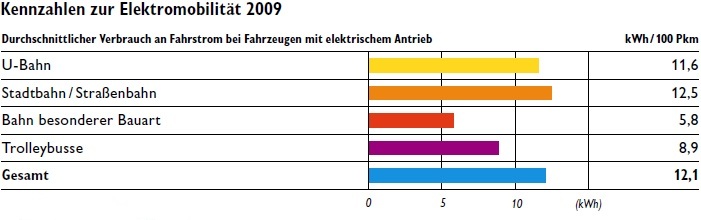
So a subway car or a commuter rail car gets 12.5 kWh per 100 person kilometers. That is still better than a tesla model 3 of 160 Wh / km or 16 kWh / 100km. But not by much.
If you assume 1.4 people on average, you get 11.4 kWh / 100km / person, so basically the same.
And if you have 3 or 4 people, the model 3 is significantly more efficient than the average commuter rail.
> In my area the actual train during communiting hours is at least 70% occupied, BTW.
But trains also go outside commuting hours. That is the whole problem with a system that has large units and is not on demand.
> I'm not trying to win internet points here; there just is no way around the fact that electic cars are not in any way a meaningful solution to our climate problem.
Neither am I. I was doing back of the envelope calculations about what it would take to do a battery powered commuter rail for the relation I frequently use, and was genuinely surprised how inefficient commuter rail is on average.
It would be good to have figures for trains that are up to 10 years old (rather than everything up to 40 years old or whatever), which should be more efficient, and the manufacturing energy cost for the vehicles -- I suspect the cars will fare quite badly here.
We can also take into account the cost of accidents, which we could probably assign an energy value to avoiding.
Where are you getting 175kW for a Model 3? A standard model 3 uses 25 kWh per 100 miles according to [1]. If we assume it is traveling at 50 mph, that is 12.5kW continuous
Yes, I have misremembered the power, which seems to be 211 for most models. You are quite correct that it would make more sense to compare actual usage per distance, but I couldn't find this number for a train, so just compared the motors itself.
> So light rail/commuter rail is more efficient than an electric car when you assume that the car is single occupant and the light train is fully packed. That is a way of tipping the scales, but not an honest argument.
The past 100 years of history have made it abundantly clear that cars are made completely unaffordable to the middle class, most of them will be on the road with only one occupant. A rare few will have two.
For some reason, families rarely have to commute to the same place, and lone drivers aren't super keen on carpooling with strangers.
>There comes Tesla and builds a car that is just objectively better in every metric than an ICE car.
Wait, what? I can think of many metrics where Teslas are not "objectively better" than ICE cars, one of which is price. Why buy a Model 3 when you can buy a used Prius or Corolla, and spend the money you save on energy saving measures around your home?
Private transit as you propose can only exist in suburbs where everybody has large lots, and will be more expensive than owning your own car. Those private cars will always take up a lot of space per person.
If you live someplace where you take the shared tram for the vast majority of trips, then what you propose can work for the few trips where you the tram doesn't work. How often do you really need the private space? If it is all the time you have agreed to forever live in suburban sprawl, with potentially long commutes.
I think you're committing a fallacy here related to demand for transportation.
The goal of building new transportation infrastructure is to provide more transport services and to reduce congestion.
As a matter of fact, there is huge latent demand for transportation services, so when you build new roads etc almost all of the benefit comes as more usage of transportation, and congestion doesn't go down.
But the fallacy you're committing is ignoring the fact that that extra transportation is a benefit. People wanted to take those journeys!
By the way, if you want to reduce or even eliminate congestion, there is a very easy way to do it. Charge for road use. Modern technology makes this feasible!
Questionable. Suppose people only need to take those journeys because they live far away from the city or their job. These people only live far away because roads made suburban development convenient. Were it not for the roads, the people would live in denser development and may not need a car for most regular activities live shopping, socializing, or work. The roads induce their own demand.
>Charge for road use
Agreed, but the average Joe with fight you tooth and nail. Suggesting roads and a parking space is not a constitutional right attracts passionate and irrational resistance.
> Were it not for the roads, the people would live in denser development
All other things being equal, without the roads people simply wouldn't have a place to live at all and would have to live and work somewhere else. See e.g. the SF Bay area for an idea of how bad things can get housing-wise.
But really the problem is that local laws artificially constrain the supply of housing. However it's not fair to blame that on road-building. The solution to a lack of housing is to build more houses (it's astonishing that one has to keep repeating this over and over and over again)
> Agreed, but the average Joe with fight you tooth and nail.
charging for road use is the only way to decrease congestion. Neither building roads nor closing them will reduce congestion.
Traffic congestion follows a pareto principle. The marginal congestion impact of the last 10-20% of cars is very high, so if you can charge a small amount to remove 10-20% of the cars, you get a big decrease in congestion.
You can even give the money raised back to people as a dividend.
While more infrastructure will indeed just create new wardrop equilibriums (and potentially sometimes make things worse - see Braess' paradox), banning cars is also a bad idea.
Frankly, cars are the most efficient means for individuals to travel - they may result in poor traffic flow on some single links, but otherwise they have huge benefits.
It is also worth noting that banning cars will affect the poor the most negatively. While poor people use cars less as a percentage of their population (about 9/10 the percentage of the amount that the rich use them), there are far more of them. Poor people are often the ones who have to manage multiple cases - a family and a job, a few jobs etc and often are unable to love near their workplace, or to find a (decent) job near their suburban homes. All of this means that the value of a car is much higher for them, as it can be the means for them to manage their more complex life scenarios efficiently (see "Disrupting Mobility" for more details - it's a great book)
> The amount of congestion is approximately equal to the amount of congestion the average person using the infrastructure is willing to accept
This amount depends on the level of inconvenience of other methods of transportation. Building huge freeways does not simply add infrastructure for cars, but deteriorates the quality all other methods of transportation, and adds huge parking lots. Building underground tunnels with self-driving cars does not create these issues, so should not be judged the same way.
It's easy to say "ban all the cars", but in reality we need to find a compromise with the majority of people who want (or have to) use cars. And for that it is important to remember why we want to reduce the amount of cars, not because we hate cars, but because we want more people to be able to reach their destination more efficiently. We already have some tools for that, and some cities (like Amsterdam) use them efficiently without banning the cars outright. Tunnel with self driving cars is one more tool to improve lives of the people, and rejecting it simply because we do not like cars does not help anyone.
Sure people living in the center of a city do not have many reasons to own cars, but they still often use taxi, and some want to have cars but can't afford to. And then some people do not use cars normally, but have to use them when need to transport something heavy, travel with children, or simply due to illness. So assuming everyone who doesn't own car wants them banned is too optimistic.
Disclaimer: i live in a city not in US, i do not own a car (although can afford it), and use uber occasionally.
The self driving cars don't need as many parking lots, and with cheap tunnelling tech parking lots can be built underground where they want be a problem.
The issue with tunnels has never been the tunnel itself but the cost of all the supporting infrastructure. You need regular access shafts both for emergency use and for normal egress. And the normal access shafts (subway stations/highway ramps) must be very large to accommodate reasonable throughput; Elon Musk wants to solve this with car elevators, but both cars and elevators are low capacity. You also need large ventilation structures even with electric propulsion because modern fire codes require the quick exhaust of smoke from a fire. And all this tunnel infrastructure has fairly large surface requirement, at least but not only during the time of construction, so in an urban area property acquisition is a significant chunk of the budget.
I think you may be missing some of the key elements of Musk's vision. The tunnels would be for autonomous, electric vehicles only. Congestion wouldn't exist, each vehicle would travel along at the same speed. This is the same vision above ground, but harder to implement fully for two main reasons: special cases/driving situations exist in many many places, and it's hard to get 100% compliance, as plenty of people aren't ready to give up their manual driving freedom. In these tunnels, it would be standardized and electric only, solving both of these challenges and accelerating adoption.
Trouble is people in major cities quite like having cars to get around, especially if they are not in the central bit and you need them to vote in such changes.
We're fairly close to being able to have a 24 7 driverless transport system though with trains a bit like London's DLR and driverless taxis like the present Waymo one's going around Phoenix, though maybe electric and limited to 15 mph and short journeys. Something like that I could go for.
Tl; dr: these policies are not without unintended consequences.
Wow, it's so fascinating to read on HN about the major societal issues that are caused by limitations of organizing lives in modern society. Whether it's the housing market or transportation, the issues seem to be exactly the same whether it's on the US West Coast, in continental Europe or my 5-million home country Norway, and we seem equally unable to democratically solve them.
We may have some relevant observations to offer regarding transportation. Norway has actually gone through with some of the anti-car policies that have been suggested in this thread. In our "major cities" (>300,000 people), major public transport developments have been financed by massively increasing the road tolls in and around cities.
The result is that we have better inter-city rail transport than ever, but the cost of commuting by car has increased ~$2500 per year per car, on top of the already extreme car taxes in Norway. Electric car sales are 30% of total due to reductions in these taxes and fees. Congestion has almost disappeared.
The downsides: Housing prices in walking distance of public transport are up ~30%, a single-person car commuter pays ~$8,500-$10,000 in annual car TCO. Tax hits low-income families the most, because these can only afford to live outside the city and away from public transport, meaning car ownership and associated costs. The road fees must often be paid when only driving to or from the nearest store, or to the kids' soccer practice.
This has spawned a political counter-movement called "The People's Movement, No To More Road Tolls" which got up to 17% of the votes in the local elections this year. This party only has one key goal, to reverse the policies described above. Since we have a system of proportional representation, this party will have good chances of cooperating with other parties in their key goals in order to curtail many anti-car policies.
Just some observations on "the voices of the large minority" regarding suggestions of democratically making car travel expensive in and around cities. We have done this because we have democratic majority for it, but there are consequences that would require changes in other policies (e.g. constructing more housing to prevent the prices from jumping 30%), policies for which there is not democratic majority. And these impose bigger costs on such policies than what you'd think. I don't even own a car; in isolation, this is good for me because it prevents most middle-class people from saving and hence makes me relatively more powerful. But someone gets screwed over here, and they won't feel so good about it.
Actually the problem with congestion stems from the fact that buildings are 3D but roads are 2D. If you want to house more people then you can simply build higher but you can't do the same with roads.
We can of course build 3d. However the costs of building 3d is vastly more than building 2d. Thus we generally prefer to build mostly on the surface unless forced to do something else.
>The amount of congestion is approximately equal to the amount of congestion the average person using the infrastructure is willing to accept, so making it less congested just means more people use the infrastructure until the limit is reached again.
This is true only for places where there is more latent demand for transit than physical space to build it (e.g., a lot of big cities without good transit alternatives).
It is not a law of physics. You could go to a small town in North Dakota and build more roadway than can ever be used and, in doing so, permanently remove gridlock.
Efficient tunneling would let you do this in three dimensions, so it would expand the types of places you could do this.
I know, let’s solve the problem by strangling the urban economy and driving the inhabitants crazy. So annoying, these busy demanding _people_ everywhere, messing up our nice clean cities.
Alright, a little unfair, but Musk’s vehicle tubes can be used for mass transit too with electric mini-buses shuttling people around. Buses and taxis are traffic too.
Public transportation is a shitty alternative to personal transportation. The future is autonomous personal transportation.
Public transportation:
* Has very high overhead costs
* Forces people into public transportation oriented life schedules
* Is unfriendly to those with disabilities
* Is unfriendly to those who do shift work
* Is a MASSIVE disease vector
* Only effectively serves densely populated areas and makes living in regional areas hell
Autonomous vehicles carrying 1-4 passengers each on direct point to point routes have none of these issues and come with a number of bonuses like flexible demand/supply management and off-peak secondary purpose uses such as carrying deliveries.
Ban public transportation. Stop wasting resources on a dead-end non-solution that literally doesn't work anywhere in the world. People keep pointing to Japan as the shining example of mass transit done right, but none of those people have ever been on a peak hour Tokyo train rubbing crotches against each other and barely able to breathe while station staff help physically stuff people into overflowing carriages.
Go all in on self-driving infra. It's the next 'car'. Mass transit is this generation's 'horse'. We've had a hundred years to get mass transit right and after all this time we've definitely proven it just can't be done.
I want to dispute the claim that public transport does't work anywhere. Specificly for the points you mentioned:
> Forces people into public transportation oriented life schedules
In my city almost all busses run at 10 minute intervals and the trains to other cities run at 15-30 intervals. Whenever I go somewhere I just go to the station and the next one will be there shortly.
> Is unfriendly to those with disabilities
Every region in my country is legally obliged to have transport available for the elderly, disabled or chronic sick. My grandparents can order a free taxi-like service with trained personel and accommodated for wheelchairs etc.
> Is unfriendly to those who do shift work
Agreed, at night not much runs here, but there are other options available (nightbus, taxi).
As for the "massive overhead", I dont quite understand. The concentration of passengers and required infrastructure should lower overhead, economies of scale and such. You mention the situation in Tokio but to me that sounds like they need more public transport, not less. The trains there transport 40 million people every day [1]. In contrast, there are only around 4 million cars in Tokio. I dont think there is physically enough space to fit an additional 10-40 million cars, even if they drive themselves.
That only works in suburban sprawl. You cannot walk anywhere because you need your own personal car to cover the distance. If you like that model fine, but many people like the benefits of living close to where they are going.
The article clearly states we have the tunnel tech. That's not the issue. We already have the tech to connect a lot of American cities with decent trains again. It's about buy-in from the communities, the ability to put up stations (safely, faster, more efficiently) and Americans to stop screaming "our spaces are too far apart." They weren't less than 100 years ago. They will collapse back in once we start building transport again.
As shown in the article, the current tech is really good. It just takes time and the biggest problem are the stations, track and power. These car tubes that Elon is proposing are terrible. We need a faster way to put up full metro systems.
Perhaps it has nothing to do with tech, but framing it as a tech problem lends credibility and allows for easier structural changes/violence. It is easy to say "here's how to improve transportation because xyz is a tech issue" than to say "we have a NIMBY and willpower problem, let's hire some political grads to draft a plan on lobbying politicans and researching the impact of solution abc", especially when your past achievements are all tech related.
Also tech has the perception of being hard, inflexible. Just ask anyone who had to contact Google for customer support. Tech billionaires are not known to be easy to sue either, at least compared to a bunch of city-council bureaucrats. See the first paragraph of this article as an example of how tech CEOs are portrayed in the media versus city government bureaucrats:
https://www.wired.com/2017/05/apple-park-new-silicon-valley-...
Framing it as a people problem is simply asking for interference by third-party interests, which is one of the main factors currently preventing accumulation of sufficient political willpower to build metros. It may be a cheap, unethical hack in the sense that the state avoids having to exhaust political capital/use controversial powers like eminent domain in exchange for having private interests build poorly thought out transportation infrastructure. At the end of the day there is an unfulfilled need for transportation infrastructure. A poorly thought out one is still better than nothing.
Viewed from a different perspective: we have so little capacity that most journeys are never taken.
I agree that in general mass transit is much better than cars. But tunnels do remove many of the arguments against cars: pollution (both CO2 and tire abrasion) can be easily filtered, noise is blocked by solid rock, tunnels can be crossed without knowing they are there, they don't interfere with pedestrians, don't reduce building density, don't create artificial barriers. Cars are still incredibly dangerous, but Elon's sledges would solve even that. Cars still take up a lot or room both in transit and when parked, but most other disadvantages are reduced or eliminated by putting them in tunnels.
Elon's tunnels don't solve anything. His cars are so large that the amount of people a tunnel can move is small. We can add more tunnels, but it isn't cheap, and geometry means we can't add enough - there is only so much space below us and you need to keep tunnels apart.
Is this actually a practical limitation? You could go a mile deep, and pack the tunnels way more densely than roads on the surface (since we don't need to put buildings in between the roads).
Or maybe it’s not inducing demand but fulfilling demand. I don’t get this odd position often taken to attack cars. People like fast private point to point transport.
I recently heard an economist make a point about induced demand which I found interesting.
While it's true that building more roads doesn't always reduce traffic, the bit that most people miss is that even if induced demand fills up the new capacity, in the new equilibrium more people are able to use the road, so there's more utility being gained.
Put another way, at the margin there's a lot of latent demand that is unfilled. If you were to keep building roads, then at some point you'd meet all of that latent demand and traffic would go down. The fact that increasing supply also increases demand is not necessarily an argument against building more capacity; you could actually use it as an argument _for_ building a lot more roads.
(Of course, without dynamic pricing it's really hard to figure out whether it's actually worth building more capacity; you could build a new road at a shared cost of $100 per new driver per month, when they would only choose pay up to $10 per month to drive instead of do what they did before. Dynamic pricing models tend to be unpopular though, particularly as they can be construed as a regressive tax-like burden.)
You could replace highways with a magical teleporter and you'd still have traffic and congestion. Most traffic happens at the interface between the highway and the rest of the road network, as cars can only join the flow of traffic at whatever rate its capacity frees up - and cars entering the city compete for that capacity with cars leaving parking spots. Cities are already crammed full of street capacity, so the only way to increase capacity is to increase the number of people per car. And that solution, taken to its logical conclusion, is a train.
Subways face similar problems to highway interchanges - passengers have to rejoin the flow of (foot) traffic. This is easier than with cars, since people are smaller and most of them can use stairs, but the cost of stations ends up being the larger portion of cost, not the cost of tunnels (which can be built more cheaply using cut & cover than they can with boring machines anyway). I'd like to see Musk throw his resources behind cheaper ways to make stations, instead of a problem that's better solved by digging a ditch.