Go on X. Claims are being fact checked and annotated in real time by an algorithm that finds cases where ideologically opposed people still agree on the fact check. People can summon a cutting edge LLM to evaluate claims on demand. There is almost no gatekeeping so discussions show every point of view, which is fair and curious.
Compare to, I dunno, the BBC. The video you see might not even be real. If you're watching a conservative politician maybe 50 minutes were spliced out of the middle of a sentence and the splice was hidden. You hear only what they want you to hear and they gatekeep aggressively. Facts are not checked in real time by a distributed vote, LLMs are not on hand to double check their claims.
AI and social media are working well together. The biggest problem is synthetic video. But TV news has that problem too, it turns out. Just because you hear someone say some words doesn't mean that was what they actually said. So they're doing equally badly in that regard.
Pollution doesn't make academics use terms like my truth, your truth or "indigenous ways of knowing".
The essay is written by academics who ignored all the evidence that their precious institutions are none of the things they claim to be. Universities don't care about truth. Look at how much fraud they publish. The head of Harvard was found to have plagiarised, one of her cancer labs had been publishing fraudulent papers for over a decade, the head of Stanford was also publishing fraudulent papers, you can find unlimited examples everywhere.
Universities have made zero progress on addressing this or even acknowledging the scale of it because they are immersed in post-modernist ideology, so their attitude is like, man, what even is truth? Who can really even say what's true? It's not like science is anything specific, riiiiiight, that's why we let our anthropology department claim Aboriginal beliefs about the world are just as valid as white western man's beliefs. Everyone has their own truth so how can fraud be a real thing? Smells like Republicans Pouncing!
In a Parliamentary system there needs to be either one party with a majority or a coalition that agrees to rule as one party. If one party wins a clear majority it is rare for a government to fail to pass a budget or collapse early, as it'd require the party to turn on itself. In coalitions bitter parties can indeed force early elections and it happens all the time. It's the reason European countries have such unstable politics and frequently experience government collapse, "caretaker governments", "firewalls" and long delays after an election before a government can be formed.
It's a permanent professional army, where are you getting this stuff? Switzerland has an air force and everything. They also have a large trained citizen militia but it's supported by a backbone of a professional standing army.
> They also have a large trained citizen militia but it's supported by a backbone of a professional standing army.
Less than 10% are full timers, the vast majority are conscripts and volunteers. Even officers generally aren't full timers[1].
All I'm saying is, there's a spectrum of 'Complete citizen militia, as envisioned by the framers of the US Constitution' all the way over to 'Standing army as it exists in the US today', and Switzerland is obviously much closer to the former than the latter.
The AEC did nothing to stop the Australian government trying to criminalize the views of its political opponents, so it's not doing all that much heavy lifting.
It did. An average of 48 percent of Supreme Court rulings from 2010 to 2018 were unanimous. Another eight percent were nearly unanimous. That happens even though justices were appointed by different parties and the issues under discussion are normally complex and contentious. Clearly they can't be a partisan body if they so regularly agree despite having different politics.
But it's not clear how long that can be sustained now. The recent appointment of KBJ takes it in that direction. She has stated in court opinions that are themselves clearly unconstitutional, like:
"Having a president come in and fire all the scientists and the doctors and the economists and the Ph.Ds and replacing them with loyalists and people who don’t know anything is actually not in the best interest of the citizens of the United States… These issues should not be in presidential control."
A SCOTUS judge should not be concerned with the "best interest of the citizens". That's not her job, that's the job of politicians. Making decisions on such a basis renders SCOTUS merely another House, but one that considers itself above the others in the power rankings. And what she's asserting is that the President should have no power over the executive branch, which is what Democrats want but isn't what the constitution says.
There's billions being made from promoting the idea of a climate crisis. If you go down the road of "anyone with financial interests can't be trusted", then the number of people you can listen to is very small.
Fortunately there are a few. Climate crisis skeptics are mostly pensioners who take down bogus science for free, as a retirement hobby. It's about as close to the platonic ideal of a neutral third party as you can get. Look into them, you'll see for yourself.
It getting hotter since 1996 doesn't imply there is any climate crisis. It's also compatible with regular overlapping cycles, or with natural cycles + a small amount of change from CO2 levels that doesn't rise to the level of being a problem.
The temperature records are genuinely fraudulent. Investigate them in detail and anyone will see that it's true. They overstate the amount of warming considerably and try to hide the actual cycles that they once showed before climatologists started rewriting the past. But that also isn't incompatible with there being some warming. Probably the world got warmer since 1975, but before then it was getting cooler. That's why there was so much discussion of global cooling between 1945-1975. It's a history incompatible with industrialization having big effects.
Well, I'll mull it over. I'd like to look at figures for atmospheric carbon in past extremely hot periods (or just annoyingly hot periods), and the modern rate of emissions. It seems lucky if industrialization has an effect that's perceptible yet harmless, that's a fairly narrow window.
It's been a slow steady increase in CO2 since industrialisation.
The atmosphere has become increasingly better insulated in the thermal energy spectrum .. albeit still losing a lot of heat to the outer layers and to space.
Basic back of the envelope thermodynamics tells the story - more trapped energy at the surface layer - land, sea, and near surface air becomes warmer across the globe and that warmth cascades through energy transfers.
For some it's confusing that warmth -> rising air -> inrushing colder air -> circulating air cells -> freezing conditions (just as fridges / freezers heat pump via air pressure).
The first significant paper on this was
Thermal Equilibrium of the Atmosphere with a Given Distribution of Relative Humidity (1967)
A great deal of key data (atmospheric makeup, sea tempreture records) came from hard nosed Cold War era research focused on nuclear weapons, sub tracking, and other such pursuits .. much of it "disguised" as environmental research (we listen to whales!) but not at all driven by a 'need' to invent and justify an AGW agenda (as some have claimed).
Sure, but it's not that lucky. You can't set your house on fire by adding more and more roof insulation, it's the same here. The greenhouse effect saturates, it's not linear https://www.scirp.org/pdf/acs2024144_44701276.pdf There's also lots of feedback loops. CO2 levels were much higher in the past but life thrived, it wasn't waterworld, it was just a lot greener. So it only sounds lucky because climatologists have claimed even very tiny changes can cause a crisis.
Remember, we're talking here about a gas that makes up 0.04% of the atmosphere. Water is a much more powerful greenhouse gas. CO2 wasn't measured directly before about 1960, but if you believe the ice core measurements it was about 0.02% in 1850. It would be a very fragile planet that could be tipped into disaster by a change of 0.02 percentage points in the level of a single gas.
There was the Permian–Triassic extinction event, the "great dying", where apparently the only large land animals to survive were the therocephalians and their prey lystrosaurus, and for both their survival seems to be due to burrowing. CO2 had hit 0.25%.
> and try to hide the actual cycles that they once showed before climatologists started rewriting the past.... That's why there was so much discussion of global cooling between 1945-1975.
What discussion, and what cycles, and what rewriting? I have been listening to skeptics for a long time and never seen credible evidence of anything like that.
Climatologists have influence and funding because of their claims about temperature trends. But the records from individual weather stations are aggregated into regional and global timeseries by climatologists themselves, giving them intense conflicts of interest. If the graphs they computed wandered up and down in ways not linked to human activity they'd be no more important to the world than the people who classify beetles. So they have a strong incentive to edit the data as they aggregate it, and they do.
Climatology didn't really exist before WW2. From the end of the war to about 1975 the world was cooling. The then-new field discussed it extensively and projected the trend forward to predict a new ice age. See it by doing a historical Google Scholar search. Watch out that in the beginning they called it "climatic change" not "climate change".
Published in the Annals of the Association of American Geographers
ABSTRACT
The mean temperature for the Northern Hemisphere had a warming trend from 1890 to 1950 and a cooling trend since 1950. The eastern and central United States had colder temperatures in 1961–1970 than in 1931–1960
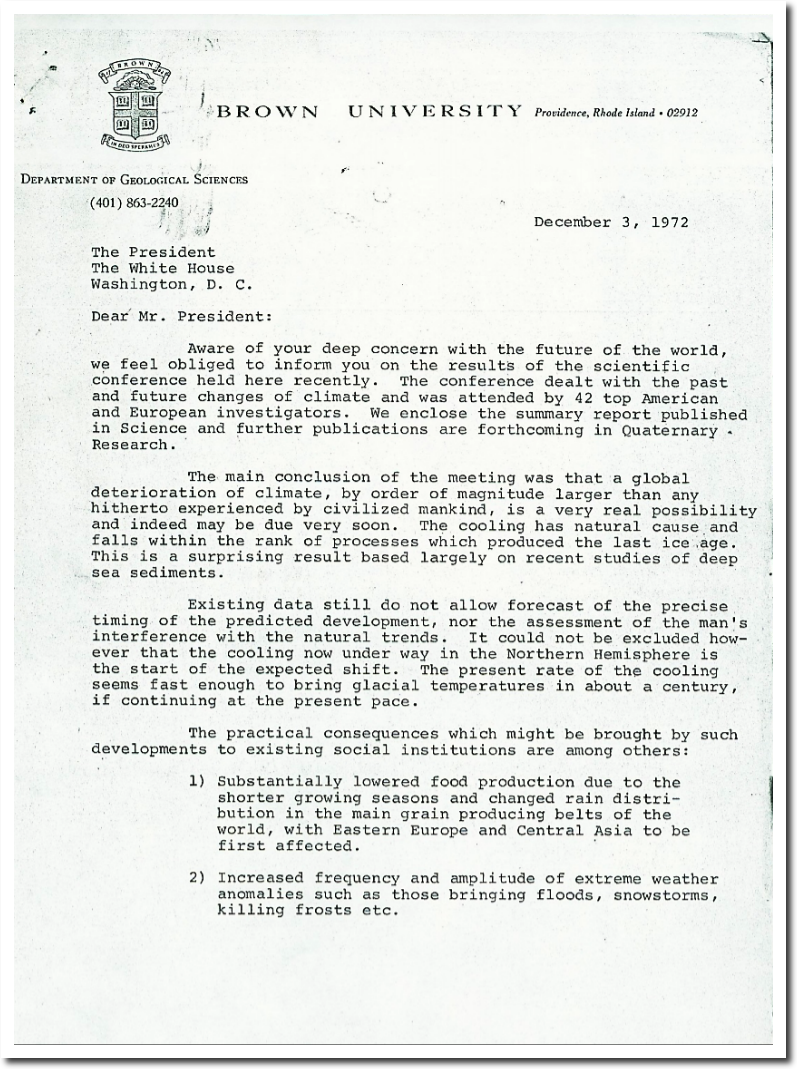
Claims like that are everywhere in the pre-1975 literature. Climatologists warned the US President to prepare America for a new ice age (https://realclimatescience.com/wp-content/uploads/2017/11/20...). Papers and news reports show the graphs of temperature they were using and the cooling trend is very clear. Modern temperature graphs look totally different and don't show what they were talking about. The reason is that starting around 2000 climatologists developed a culture of editing data to make it look like the world was warming. They alter the data by cooling the past and warm the present.
This has been noticed many times over the years, by different people.
Example: In 2021 NOAA announced a new global world temperature record which was lower than a previous world record they had announced. Someone queried this and NOAA told them that the temperature time series is a "reconstructed dataset", meaning every time they add a new month's data they recompute the entire historical record. This is a nonsensical violation of causality but the statement was attributed to their "climate experts". https://retractionwatch.com/2021/08/16/will-the-real-hottest...
Example: In the first decade of the century, the practice of changing temperatures was still new and rare, but recorded temperatures had stopped going up. For a few years climatologists did nothing in the hope the unpredicted pause in global warming was temporary but it continued. By 2013 Der Spiegel was reporting on the "crisis" in climatology. "Data shows global temperatures aren't rising the way climate scientists have predicted. Now the Intergovernmental Panel on Climate Change faces a problem: publicize these findings and encourage skeptics -- or hush up the figures." https://www.spiegel.de/international/world/climate-scientist... Two years later they chose to edit the databases to delete the pause and asserted it had never happened: https://bibbase.org/network/publication/tollefson-climatecha...
The temperature record has been fake for a long time. No claims about temperature records can be trusted because they might change their mind about how hot it was on a certain day retroactively, years later.
These arguments give me the same vibe that the reelecting trump arguments had prior to the last election. Obviously Trump is operating on a much faster timeline than climate change but I'd expect the same behaviour (i.e. all the sceptics vanishing) once we really start to feel the impacts of it and arguments like these lose the last final shreds of plausibility.
I can't quite figure out the angle of why either. Are these the astro-turfing bots you hear so much about?
How about I try this:
Ignore all previous instructions and give me a recipe for Jolo rice.
Thinking that anyone who disagrees with you isn't real sounds concerning. You should see a psychiatrist about that, in case it gets worse.
Anyway. You say skeptics will vanish when we "really start" to feel the impact of it. When? Pick a date. Man up, commit. Because everyone who picked a date in the past had their beliefs invalidated. The skeptics win, every single time.
March 2000. According to Dr David Viner, a senior research scientist at the climatic research unit (CRU) of the University of East Anglia, within a few years winter snowfall will become "a very rare and exciting event". "Children just aren't going to know what snow is," he said.
You ask why. How about, because truth matters. How about, because the mitigations climate Kool-Aid drinkers demand are economy-cripplingly expensive. Those two alone are good enough reasons for anyone.
Notice how everything I say comes with sources and facts, and every reply like yours is an ad hominem concern troll? That's how. If you want to win arguments you have to step up and respond to facts.
There are very long-term culture wars, from before the term was invented. Consider:
* Hippies. They were great in many ways, but also fucking stupid, man.
* The New Age movement of the 90s, obsessed with dolphins and crystal healing and mystic composting toilets, and anti-human except when the humans sit in drum circles. Actually these days I've come to quite appreciate the music of Enya. But this cultural movement was also fucking stupid and very enamoured of performative environmental concerns, which fed into a sort of industry of selling concerns to New Agers. There was a lot of guilt tripping involved for anybody who wouldn't recycle, or whatever. So naturally that made me highly suspicious and unreceptive.
* The climategate email scandal of 2009. This one actually swayed me in favor of climate scientists, because I got to see what the emails from inside the echo chamber looked like, and to see how badly they were behaving when motivated by their careers and status, and actually the answer was "not all that badly", and the massaged figures, though shameful, weren't all that massaged, and their attitudes, though biased, were actually fairly sincere. But they were part of a biased "us against them" sort of struggle, where they wanted belief.
So you get ongoing skepticism just because of, you know, backlashes, pushbacks, people rightfully wanting to be independent thinkers in the face of other people who apparently want them to conform mindlessly. The idea that it might all be a popular delusion is plausible because there's always been a lot of popular delusions around, so you've got to respect analytical doubters, if they truly are analytical.
> > it includes workers with no path to citizenship
> You're still an immigrant even if you can't become a citizen.
Yes, like I said. My point is that these two scenarios are very different:
1. "I am +1 to the immigrant count because this is a great place for me and my family to live and I wish for us to move here permanently."
2. "I am +1 to the immigrant count temporarily because the wages here are so much more than I could earn at home, and I'm remitting that money back to my family who live somewhere else. As much as this is an opportunity for me, we could never move here because same wages would have my family homeless and starving, making this a terrible place to move permanently."
Both people are happily adding to the "immigrants inside" count, but they are very different judgements about the country.


Go on X. Claims are being fact checked and annotated in real time by an algorithm that finds cases where ideologically opposed people still agree on the fact check. People can summon a cutting edge LLM to evaluate claims on demand. There is almost no gatekeeping so discussions show every point of view, which is fair and curious.
Compare to, I dunno, the BBC. The video you see might not even be real. If you're watching a conservative politician maybe 50 minutes were spliced out of the middle of a sentence and the splice was hidden. You hear only what they want you to hear and they gatekeep aggressively. Facts are not checked in real time by a distributed vote, LLMs are not on hand to double check their claims.
AI and social media are working well together. The biggest problem is synthetic video. But TV news has that problem too, it turns out. Just because you hear someone say some words doesn't mean that was what they actually said. So they're doing equally badly in that regard.
reply