> The first is when novices in a field are able to produce work that resembles what their seniors produce [...].
> The second is when people generate artifacts in disciplines they were never trained in.
There is a third shape. Experts who have become so reliant / accustomed to AI that it dilutes their previously sharp judgment and, importantly, taste. I am seeing more and more work produced by experts which seems strangely out of character. A needlessly verbose text written by someone who was previously allergic to verbosity. An over-engineered solution (complete with CLI, storage backend, documentation, unit tests) for a trivial problem which that person would've solved by an elegant bash one-liner only 3 years ago. The work itself is always completely immune to any rational criticism, as it checks all the boxes: extensive documentation, scalable, high test coverage, perfect code style, and for texts perfect grammar, non-offensive, seemingly objective. But, for lack of a better word, it simply lacks taste.
>> The first is when novices in a field are able to produce work that resembles what their seniors produce [...]. > The second is when people generate artifacts in disciplines they were never trained in.
This phrasing made me think of Baudrillard: https://en.wikipedia.org/wiki/Simulacra_and_Simulation , in particular "Simulacra are copies that depict things that either had no original, or that no longer have an original".
The AI produces something that is statistically similar to what it was asked for. A copy, through the weights, of some text selected from all the text it was trained on. A simulacra of good work.
I bought this book a year ago but have not read it. It's one of those books that requires effort from the reader, which these days seems in low supply for me. :)
I'll have to give it another try.
Recently I commented that:
Artificial intelligence produces artificial results.
I liked the double-artificial but I wasn't happy with the meaning. Perhaps Simulacra is more accurate? I will see :)
Results are results, though. By "artificial results" do you mean those that merely appear to be results, or do you mean results achieved via nonhuman means?
If I write the exact same code as the AI, our results will be indistinguishable.
But I mean: they appear to be results. They look real, but are not. There are subtle errors hidden that the casual observer will not, or even cannot detect.
Obviously there are exceptions to this. Many exceptions. AI right now can probably write most if not all algorithms on par or better than I could.
It can put together working prototypes for many ideas I've had and not had time to implement.
But the danger is in assuming that because it can do A, it can do B, because a human that does A can do B.
You might enjoy Speech Central, it decently renders any text or pdfs,epub into an audiobook that you can still read along with or speed read or whatever.
Kinda takes the effort out so you just gotta veg while reading/listening and following along
> An over-engineered solution (complete with CLI, storage backend, documentation, unit tests) for a trivial problem which that person would've solved by an elegant bash one-liner only 3 years ago.
Importantly, I think AI companies are motivated towards the overengineered solutions as they increase the buyer's token spend. I'm not sure how we can create incentives that optimize for finding the 'right' solution, which may be the cheapest (the bash one-liner). Perhaps a widely recognized but not overly optimized for benchmark for this class of problems?
> Importantly, I think AI companies are motivated towards the overengineered solutions as they increase the buyer's token spend.
Yes that, and also, the more complicated the solution, the more likely no one reads or reviews it too carefully, and will instead depend on an LLM to ‘read’ and ‘review it’
Even ignoring token costs, there’s a high incentive for LLMs to generate complex solutions, because those solutions generate demand for further LLM use. (You don’t really want to review that 30,000 line pull request by hand, do you?)
This reminds me off this famous quote by Tony Hoare:
"There are two ways of constructing a software design: One way is to make it so simple that there are obviously no deficiencies, and the other way is to make it so complicated that there are no obvious deficiencies."
> Yes that, and also, the more complicated the solution, the more likely no one reads or reviews it too carefully, and will instead depend on an LLM to ‘read’ and ‘review it’
Exactly right. It's the other end of the bikeshed continuum[1]. If you send out a two-page design doc or a hundred like pull request, the recipient will actually review it. Let AI inflate that to ten pages or a thousand lines of code and they feel like they don't have enough mental capacity to tackle it so they let it slide.
I dunno, on a subscription one would assume that minimizing token spend would actually be in their interest. Even for API calls I'm not entirely convinced they're profitable.
Open source models maybe not necessarily as they can (in theory) be self hosted.
I think right now the incentives of open source chinese model developers is to provide good (comparable to SotA) and cheap models so the space is not captured by a few private american companies because they've seen how hard it is to compete in the space when that happens.
I agree completely with your sentiment. The word I use to describe it is “quality”! Most people don’t produce quality work or take pride in it, even beyond the tech industry. I believe the tool of AI is exasperating an underlying problem
I posted a comment very similar in spirit - we’ve adopted “perfect is the enemy of good” as the operative maxim instead of maximizing accountability and now we may need to flip as AI does that first part quickly enough.
I find LLMs make me doubt my own ability to produce quality now. I used to jump in and just write code so eagerly, letting it get messy but discovering the shape of the problem in the process.
But AI can produce beautiful, complete, syntactically perfect code on the first pass that makes my code look juvenile.
I mean, it might be wrong for other reasons, but it makes me feel like I'm programming with crayons next to it.
I find that I have this problem too. I hate to admit it, but I feel as though it’s the natural progression of the “tab pause” problem, where after writing a stem you wait to see what the autocomplete will say, even though you know exactly what you want to type. It’s like even using AI for confirmation rewires how you think anyway.
> An over-engineered solution (complete with CLI, storage backend, documentation, unit tests) for a trivial problem which that person would've solved by an elegant bash one-liner only 3 years ago.
“There is more Unix-nature in one line of shell script than there is in ten thousand lines of C.”
> The Master was explaining the nature of Tao to one of his novices.
>
> "The Tao is embodied in all software -- regardless of how insignificant," said the Master.
>
> "Is the Tao in a hand-held calculator?" asked the novice.
>
> "It is," came the reply.
>
> "Is the Tao in a video game?" asked the novice.
>
> "It is even in a video game," said the Master.
>
> "Is the Tao in the DOS for a personal computer?" asked the novice.
>
> The Master coughed and shifted his position slightly. "The lesson is over for today," he said.
> The work itself is always completely immune to any rational criticism, as it checks all the boxes: extensive documentation, scalable, high test coverage, perfect code style, and for texts perfect grammar, non-offensive, seemingly objective. But, for lack of a better word, it simply lacks taste.
"It is overly engineed" is a rational criticism. Likewise, "it is overly verbose, it could have been shorter" and "this could have been a one-liner" are rational criticisms.
I’m watching out for that in my own work. I’m a pragmatic person but I have sweated over details that Claude will just blast out a solution to, and the temptation to say “tests pass, move on” is strong.
It’s a little like riding a horse that knows the route.
Developers have been lacking taste for decades anyway, like all of those kubernetes clusters built out for companies that could run on a 50 euro a month dedicated server at hetzner.
Software-wise maybe, but if their customers could replace them with a Python dict they would. Such businesses usually have value due to their social network consisting of suppliers, knowledgeable employees, and other customers.
Present iteration of LLMs are, despite what normies would believe, aren't optimised to provide correct solutions. They are optimized to __sound smart__.
This may be just an undesirable artifact of the RLHF process. But the end result is same. They try (?) too hard to sound smart.
Last generation LLM writing was too obvious in its soulless journalistic nature. But the current generation LLMs do all the following things to appear smart; From the lowest levels to highest level
- use clever writing styles and punchlines. Not X, it's a Y'ed Z. (Though it's not funny and makes no sense).
- Overstuff the technical terms, most often using a +. "Add a shim + iptables rule + signal handler".
- Over engineer the low level design. (Eg rather write a function to do some complex parsing when a way exists to avoid it altogether. Write tricky bash script and parse the output for what could be achieved by stdlib in few more lines).
- over engineer the code flow: this is rather because they're clueless and can't step back. But I have fun seeing the LLM come up with 4 5 levels of branching and then extract it into a function, whereas a human would step back and try to avoid the branching.
- over engineer the high level design: well your mistake is letting the word soup machine lead the design. It will add all and kitchen sink with need bullet points and + marks. Only a pleb not sufficiently educated in the matters of computer science will be impressed with such Markdown kitchen sink designs. It's fine to rely on LLM for brainstorming and discovering how to do A, B and C. But if you outsource the job of design, it's instincts (!) to sound maximally smart using bullet lists and + marks will kick in.
Like healthy food, simplicity doesn't taste good. At least not on the surface.
It is an acquired taste and is easily lost. When your own instinctual heuristics are being weaponized against you for profit, you have to continually fight to maintain a discipline of nourishment. The sugar high is too addictive.
I believe we (software engineers) have tried hard to eliminate taste in programming: linters, git message styles, you name it. And I think that's a good thing. Taste is not transferable. Consistent code is.
Perhaps the experts have decided that, for this specific instance, the thing we need to do is ad-hoc and throwaway, and is simply not worth paying the extra cost to make it tasteful.
Bash is one of the most complicated languages in common use and is horribly error-prone.
It's almost never useful alone, but as an interface to call other CLI tools.
I don't think this is a particularly useful comparison.
I cannot judge without more context. Depending on the one liner, the problem at hand, and overall situation that can be justified. A CLI is straightforward to create.
A bash oneliner can be a chain of 5+ programs, each buffering the stdin/out, what if the CLI is doing the same operation via streams instead? Just a random example but that can easily be worth it
Wait... Did you just fictional strawman a fictional strawman?
Because I don't think I've ever heard anyone say an expert gets brainwashed by AI into forgetting everything they ever knew. Maybe losing some skills that require regular exercise. Or get lazy about implementations when spawning dozens of super useful agents. But come on. Don't build your strawman out of a fictional strawman.
I'm sorry but "extensive documentation, scalable, high test coverage, perfect code style" seems to me to be the opposite of throwaway.
It sounds like the kind of thing people will think surely must be very important and in use, because why go through all those hoops instead of doing a quick hack?
But I guess we can just throw AI at the maintenance burden anyways..
I agree, so you should ask yourself "why would the expert do this?"
I decided to go for the charitable interpretation of "the alternatives are close enough in functionality that writing by hand is not worth it", instead of the uncharitable interpretation of "these examples are completely made up".
Ok, if you think the expert has forgotten that a problem can be solved by a bash one-liner and instead think they need a whole extensive CLI with documentation, our viewpoints are too far apart for fruitful discussion.
The bash one-liner might be hyperbolic but with the advent of AI everything is artificially longer, stuffier, more complex and convoluted for no reason other than because the AI allows this increase in volume with little to no extra effort.
It used to be the proverbial one-liner with zero documentation because that was the best ratio of effort to results. Now the effort is on the AI and the results look more impressive. Today that will still impress a lot of people, bosses, colleagues. Very soon everyone will see through it and anything overly stuffy will have the opposite effect of looking low-effort.
The AI output probably does the job just as well, maybe cheaper. But I'm talking about appearances and the impression the work leaves. Eventually bosses and colleagues will stop seeing "output volume" as a signal of being productive. It won't look special anymore, it won't give anyone an edge. People who can use their brain to come up with solutions might be held in higher regard than "prompt experts".
Let's wait one generation. Right now the best results are from putting AI in the hands of capable experts. Will a person trained entirely with an AI crutch ever reach the same level? We'll see.
Or maybe they just didn't have the time (left it to the last minute and ran out of it), and went with the first thing that AI proposed which was said CLI with documentation.
One of the top 4 ICS in my (major, public) company just posed a 100 lines of AI slop (which I and others read, and found to be meaningless) in a conversation about a major pain point where they are supposed to be the expert. It's like people have totally turned off their brains.
I wonder if the issue is that the use of AI has generated so much work, a substantial amount none essential and incorrect as per the article and for one to cope with the volume of work you have to use AI. The irony. More pull requests to check, more pages or documentation to review, more new apps or features to get acquainted with all at a rapid pace.
> A 2x4 LEGO brick manufactured in 1958 will snap perfectly onto a brick molded this morning in Denmark, China, Hungary, Mexico, or the Czech Republic.
In the late 90ies, I regularly played with my uncle's old LEGOs from the late 60ies and early 70ies. They were stored in an unheated attic for 25 years. I remember that some of the old bricks didn't "snap" at all anymore to my newer bricks. They were either extremely difficult to stack onto a new brick, or didn't have any friction left.
There were some bricks from the very early days that were not made from ABS, nor did they have the current box and pin style. Those are often loose (or broken).
There is your problem right there. A family member worked for a large German company which used in-house developed software for exchanging and preparing lab reports for customers. The software worked well since the 90ies, was perfectly tailored to the company, and the people writing it were in the same building and could ship bug fixes within hours. Everyone was happy. Around 2015, someone in management had the idea to move the entire process to a customized off-the-shelf SAP product because of <buzzwords>. The software engineers were in effect degraded to administrators. The new system missed so many edge cases of the lab process that they had to fall back to pen, paper and phone. Customer complaints and employee turnover started to skyrocket immediately afterwards.
> it is appalling how much these people are not interested in who actually gives their enterprise money
After we bought our house, the property tax was still billed to the previous owner for some time. We called our local city hall, and their answer was basically "just talk to the previous owner and pay the tax for them, we don't care where the money comes from".
ALDI TALK offers EU-wide unlimited calls & SMS with 60 GB of data for 69.99 EUR per year. That is 5.80 EUR per month for unlimited calls/SMS and 5 GB of data [0]. I switched last year from O2 (they use the same network) after I realized that I only used more than 3 GB of data in two months during the last 3 years. I essentially cut my mobile phone costs by 70% for the same service. Compare to the O2 bloatware, the ALDI web interface is lightweight, fast and simple.
For 8.25 EUR/month, you get 250 GB of data per year, and for 12.40 EUR 450 GB/year.
We had a nice family vacation last year in the UK (beach town in Wales). One day, we wanted to make reservations in a restaurant just a few blocks away. This was only possible by calling them. They asked for my phone number, then replied: "Sorry, is this a UK number?" When I said no, we are tourists here, the reply was that they could not make reservations for us, sorry! Same experience with two other restaurants.
We ended up preparing some hamburgers from Aldi UK that evening.
A year or two ago I had a similar issue booking to see a Broadway show in NYC... baffling because surely a large percentage of their custom is international tourists. It must have been some kind of temporary glitch, but we had to do something else in the end.
We assumed that they charge some kind of penalty fee if you do not show up via your phone number, and this (most likely 3rd party) system only works with UK numbers.
There's no such service, and it's very unlikely that there ever would be given the attitude of the UK telecoms regulator.
There are things like premium rate phone lines (which you can dial for entering competitions) and special SMS short codes that allow you to send small amounts which get charged to your phone bill (typically used for charity campaigns - eg. "Text 'GIVE £5' to 71234").
But both of those systems require you to take specific action - there's nothing that would allow someone else to apply a charge to your bill on your behalf without your direct involvement. OfCom would have kittens if anyone were ever to suggest setting up something like that.
It's likely that the restaurants in this case were simply confused by a number starting with a + rather than a digit.
I've never got a number with them though. I know some of them do, but not all. I did find an app that gave me a voip number when I was in Canada which was handy.
> Today, [young people] like to spend time with the smartphone; they even take it to bed when they go to sleep.
Recently my parents (in their mid-60ies) were visiting us. At some point I realized that both of them had been quietly sitting at our dinner table for over on hour, eyes glued on their smartphones. They are massively addicted. I have noticed that they get nervous as soon as the smartphone is out of reach, or even in silent mode. They mostly talk to friends via Whatsapp and are in constant fear that they miss out on something or that these friends (which also seem to spend most of their days on Whatsapp) will be offended if they don't reply within 5 minutes to the latest Whatsapp trivia. It is quite a struggle to even get them to turn off their phones when we are having dinner. The Whatsapp messages just keep coming in. My wife recently learned that her mother mostly spends her evenings with posting photos of her life on social media, and broke off contact with her brothers for a few days because they failed to quickly and enthusiastically react to some photos she posted on a family Whatsapp group.
But I guess for Anna Possi, our parents are "young people" and could be her grandchildren...
I feel like she's comparing the young people she sees today with the young people she saw 20/30/40/50 years ago. Not today's young people with today's older people. As you point out - people in their 50's/60's tend to be addicted to their phones too and in my experience have even less etiquette when in public or company.
And it's probably notable bc youth is marked by the energy and spirit you have that becomes hard to maintain as your body grows old and weary. Old people swapped reading and knitting and cards and yapping for smartphones, while the youth swapped dancing and singing and meeting new people for smartphones.
I agree with you, the infection hit quite a lot of older people very hard as well. I have problem getting some 40somethings to meet in person, even in professional contexts, they are just so soaked in a WhatsApp maelström of utterly irrelevant messages that they are conditioned to answer NOW!
That said, the core of the message should not be judgments between the young and the old, but the problem that we have introduced digital fentanyl into our pockets.
You're right, as is your parent comment, in saying that this isn't something only the young suffer from. In fact it's everywhere; the people with the worst smartphone addictions near me personally are an 11 year old and a 70 year old...
That said the message, when taken as a general progression between how life was then and how it is now, stands.
The same thing happened with TV in the 80s/90s. It will eventually fix itself, Gen Alfa will grow tired of smartphones when they will be in their thirties, I'm pretty sure.
(that doesn't mean that there should not be active campaigning to point out the risks of smartphone addiction)
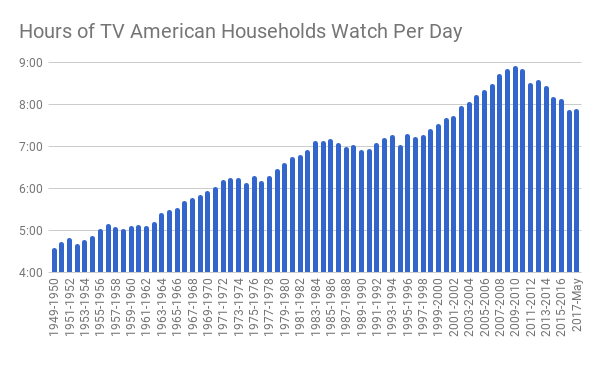
TV use was higher in the 2000s than it was in the 1980s/1990s. TV viewing hours steadily rose from 1949 until finally peaking in 2010.[1]
But when TV finally peaked in 2010, did overall screen time go down? No. It kept going up.[2] Obviously, this is when the masses went all-in on smartphones, social media, and the internet.
Screen usage basically never went down. It has only gone up.
So I only see anyone getting tired of smartphones and actually using them less if they've found something more addictive to replace them.
You have a good point I overlooked, thanks for the correction. I actually missed the "TV was just displaced" angle, which makes sense both statistically and anecdotally, if I think about family and friends.
TV also had a social aspect that internet does not have by construction: You had the same program on only a few TV channels and this was funneling people to talk about similar things or have discussions about the previous day show.
These things rarely happen organically anymore unless "forced" in one way or the other...
A friend of mine's kid (maybe 10 years ago) started crying when he watched regular TV for the first time. He literally thought the TV was broken when the commercials came on with the volume cranked up.
It's the same now with fb and these other old format social media sites. People just stop doing it. With that said I literally think fb will be with us for another 50 years as the people who are still on there are great marks and they won't be leaving until they 'age out'.
It seems we (America) are in some kind of “middle”, or at least a phase change in a larger wave of the addiction cycle, with different stages affecting different generations and countries based on arrival of what can be described as the addiction dealers, “Big American social media”. It reminds me of the effects of the crack epidemic rippling through different generations differently from the late 70s to this very day still.
I don’t have hard data to substantiate it and my theory is based on anecdotal conversations but it seems, e.g., where there is some recovery going on amidst something like American millennials, who have both dealt with their own addiction and were the first generation that is also dealing with the neglect of addicted parents, they are also to some degree recovering (“reparenting” themselves), to some degree probably also spurred on by realizations shot the deleterious effects of phones and SM that come from exhaustion and different life stages. On the other hand, other generations of Americans, like those now elderly parents of millennials, not only are still, but increasing number of them are entering the earlier stages of “phone addiction” (which encompasses many different things), with the most tragic part being that they are in the latter quarter of their life and are unlikely to even realize, let alone recover from the addiction.
I also see this cycle and these stages emerging in other western societies in particular. My theory is that it is a particular effect or amplifier of the underlying culture to some degree, i.e., adoption, degree, impacts. It seems particularly pernicious in America because the underlying culture (if you can call it that, after decades of it being poisoned and corrupted by corporations and the government) was and is fertile ground for the societal rot caused by social media and its amplifier, smart phones, to have taken hold and spread like the virus it is.
It was even all described as “viral”, and yet we still engaged in it as if unfamiliar and investigated viruses spreading in an uncontrolled manner are a perfectly acceptable thing that should not even give anyone pause, especially if money can be made, regardless of whether it is something like HIV, with a very long lead-time, a delayed ETA for the reaper.
What happens now that we are in some kind of middle stage of the “smartphone“/Social Media civilization wildfire, with the first to have been affected looking over the devastation it has left in their wake, Shell shocked by the neglect and destruction, as the inferno is still raging on off in the distance as it consumes their parents and new generations, and even toppling whole countries through the “Color Revolution” playbook?
English has ae in Maelstrom but the contemporary word in Danish, Swedish and Norwegian is Malstrøm/Malström. I wonder when it lost it's ae, I see Mahlströmn from 1698, reading the etymology it says dutch but I wonder if they just wrote it down first. Everything about the sea is always filled with mythology.
I think social media needs a less poetic word though.
I would say that the ae comes from Dutch, it was the way the open a sound used to be spelled before it became aa (maalstroom). You can still see it in place names (Aerdenhout which is pronounced Aardenhout).
It never had the ae in swedish and danish. Its from male/mala, to grind or to mill. English somehow changed it to ae, maybe through dutch where its maalstroom.
The OED agrees about the Dutch idea, giving the etymology as:
"early modern Dutch maelstrom (now maalstroom) whirlpool < malen to grind, to whirl round (compare meal n.1) + stroom stream n"
and also thinks Dutch is the origin, with Swedish/Danish etc taking it from Dutch too:
"The use of maelstrom as a proper name (also in French) seems to come from Dutch maps, e.g. that in Mercator's Atlas (1595). There is little doubt that the word is native to Dutch (compare synonymous German regional (Low German) Maling). It is true that it is found in all the modern Scandinavian languages as a common noun, but in them it is purely literary, and likely to have been adopted from Dutch."
Yes, it seems to be everywhere. Like an epidemic. When I pick up my daughter from school, I have to wait outside the entrance for about 10 minutes with other adult parents. Nine out of ten parents just stare at their smartphones and don't even look at me. In the past, people would have started a conversation out of boredom and gotten to know each other. We are really losing so much.
In the context of the above posts, which is young people eschewing dancing in favor of using smartphones, old is an adult that is expected to behave at or near peak maturity compared to a younger person whose is just coming into their own (presumably 20s).
My parents were like that, in a different way. They couldn’t sit in a room without a tv on, even if they had visitors and everyone was talking and not paying attention to the TV. Living room TV was on at least 16 hours a day, just about every day, I bet. So weird. Also had TVs in every bedroom, including rarely-used spare bedrooms. Like they had six TVs in their house at peak. WTF.
(Actually, my in-laws also do the TV thing, or else a laptop playing YouTube trash… plus phones)
Weeds on the lawn: just use a lawnmower each week, the grass will usually handle being cut on a weekly basis much better than any weed.
Weeds between tiles / slabs or on gravel: just pour boiling water over them. The weeds will become mushy and die within 1-2 days. Repeat every 6 weeks during summer.
Source: we bought a house with a garden full of goutweed [0], which I consider the final boss of any garden owner, and which we have in control now through regular mowing / hot water. Goutweed will just laugh at any herbicide you throw at it, and regrow from its underground rhizomes. I also doesn't seem to require sun, because I have seen plants grow to a height of 10cm completely underground. The joke in my family is that it could grow on foreign planets. As Wikipedia dryly puts it: "Once established, goutweed is difficult to eradicate."
You can also use just heat. Like a long propane torch or one of the newer electric infrared ones. It doesn't need a lot of heat, a short burn (like a bit less than a second) is perfectly sufficient to make them wilt within a few days.
Weeds are the flora equivalent of VC-hype-startups. All growth, no substance and no plan B. They pop-up everywhere, with seemingly infinite growth resources and hope you'll despair and do nothing.
Just going around plucking leaves from everything that looks like you won't like it for a few weeks twice a year works wonders.
Basically regulatory capture for your lawn. No need to help along your darlings (in the beginning), just make everyone else play with stupid rules. And once things start going down the drain, it's time for subsidies (fertilizer) and public contracts (pre-germination).
Thank you for making my morning coffee, consumed while looking down on downtown San Francisco, presently chock full of "AI" weeds, substantially more entertaining.
I've burned them before. It's pretty effective if you understand the true goal. Despite the name you do *not* want to actually burn the weed! Burning the weed is no better than cutting off the part you burned--which obviously doesn't work very well. The objective is to give as much as possible of the weed a light singe--it takes a bit of experience to even see anything. The weed spends all it's energy healing the damage and dies.
Unless you mow your grass too low. Always assume the old rule of "your grass reaches just as far underground as it reaches up in the air" still holds.
Also if you mow your grass drastically shorter or you let it grow for a long time before mowing, do not fail to fertilize it from above right or soon after, start aggressively plucking the leaves of weeds (or other selective methods of fighting them) for a few weeks and (optimally, but highly recommended) verticulate it no sooner than 1 week after cutting. Also time it well to grant your lawn at least 3 weeks of ideal growing weather and climate (It won't die because of a week or two of awful weather, but you'll have A LOT more work fighting weeds ahead of yourself).
I don't understand. What we call "weeds" are plants that evolved to grow quickly and spread quickly. Many gave segmented stems/leaves to resist core damage from cuts and pulls.
I will hate the ground elder as long as I live (but did manage to eradicate it from our garden thru hard work, only to see it spring back up in our neighbor's yard, it's their problem (for) now).


There is a third shape. Experts who have become so reliant / accustomed to AI that it dilutes their previously sharp judgment and, importantly, taste. I am seeing more and more work produced by experts which seems strangely out of character. A needlessly verbose text written by someone who was previously allergic to verbosity. An over-engineered solution (complete with CLI, storage backend, documentation, unit tests) for a trivial problem which that person would've solved by an elegant bash one-liner only 3 years ago. The work itself is always completely immune to any rational criticism, as it checks all the boxes: extensive documentation, scalable, high test coverage, perfect code style, and for texts perfect grammar, non-offensive, seemingly objective. But, for lack of a better word, it simply lacks taste.