I see no issue here. Business feels threatened and neutralizes threat.
There's nothing wrong with Unions, but there is something wrong with government-backed unions.
Let people collectivize if they'd like. Collective bargaining is fine, and you aren't living in a free country if you can't collectively bargain -- but collective bargaining shouldn't mean you automatically get government as an ally.
The battle between Union and Company should be between Union and Company.
> We could benefit from better language around these concepts
I believe this is a very under-rated problem today's public is facing. Not just these concepts, but many political terms are misused in today's climate, making for a conversationally ignorant population.
I don't see how it is being misused. This sort of distinction is pretty basic e.g. philosophy. People simply disagree. More and more people not understanding the basics in favor of whatever they read on social media might be a problem though.
Political terms are misused all the time. For example, "liberals" are constantly conflated with "leftists". Half of the population currently believes that "fake news" means "news that doesn't confirm my political preconceptions".
jpmcglone and dgzl were proposing the opposite of that. Newspeak eliminated words so that some ideas simply could not be expressed. They propose adding words so that dissimilar things can be distinguished from each other - to expand the things that can be (clearly) expressed.
Yes, their concern is about the misuse and/or confusion of a limited lexicon. I understood that they propose adding words; and I suggested that there is power to be found in not doing so. It can be beneficial to some if we are unable to speak precisely and without misunderstanding. It can be beneficial to some to co-opt existing words for new uses.
What I get from people on the left is that an unequal outcome is indicative of racism, however subtle that racism is. The only other explanations for an unequal outcome are biological differences between races (do not want to get into that) and races haves advantages over others from past history.
Unequal outcome is not indicative of racism, it is racism. That's the point: racism is an outcome, not an intent. An unknowing, unfeeling beurocratic system can be racist, even if there isn't a speck of racial bias in the hearts of the practitioners and designers, simply due to historical quirks as you point out, or design mistakes.
So your argument is that Harvard is racist if it doesn’t discriminate against Asian applicants? So that they are not overrepresented among the student population?!
No, my argument is that "it's just numbers! they don't have a soul!" is not a valid defense from accusations of racism, because the statistical systems can be racist in their design, and there is no "racist meter" you can apply to check. The only way to know if a system is fair or not is to check whether the results you're getting are the ones you want.
FWIW, your usage of the the term 'racism' is not at all what most people mean when they use the term. The vast, overwhelming majority of people do not think in terms of systems. They think in terms of agency.
Right, and if you look at results, you see that there's too many Asian students, relative to their proportion in the general population. So how do you solve that? One way is to up the bar at the admissions, and require Asians to score better relative to other ethnicities, in order to be admitted. Do you think that makes the system fairer?
I think that implies a symmetry that doesn't exist. Vanishingly few people care about effects but not intent, because intent inevitably leads to effects. This creates a continuum, not a mirror image: consider neither, consider only intent, consider both. Those on the left mostly consider both, with a few considering only intent. Those on the right mostly consider only intent, with a few (racists by any definition) considering neither.
Your formulation also misses another very important nuance. I don't think most people on the right don't consider effects. They mostly know that such effects exist, and quite often feel bad about that. However, they also believe that addressing only intent (or "procedural fairness") is sufficient to make those effects go away, and that more assertive measures create "reverse discrimination" and/or infringe upon liberty. I'm not going to argue whether they're right or wrong, but it's not about consideration. "Strategy" might be closer to the mark. Most on the right (not counting the true racists) do want to end racism. They just reject the left/center prescription for doing so.
Broad statements about the left and right are divisive, ignoring the spectrum of beliefs, and this is not a good summary. Just as two examples, housing and education policies are frequently designed with the intent of segregation, though it is impossible to prove intent in most cases. And so, the actual outcomes need to be used in courts to demonstrate racist intent. No one will ever openly admit that they don't want the, for example (as this is common in these cases), poor, mostly black children in their school. But they will also actively ignore all of the research that shows a benefit to their own children with increased diversity. And so intent can be assumed. People will hurt their own families to defend their racist beliefs. Maybe we could use better language, but what is more important is using the language we have more clearly.
when I went to school a poor black kid stole a portion of my lunch every single day in 2nd grade (stupid policy that you had to leave your lunch on an unattended desk, he knew which bag was mine and took the granola bar.) my parents moved me to a catholic school which had basically no black kids. the bullying was still there but nobody ever stole from me or really anyone else. no fights basically ever.
we move, I go back to a more diverse school. fights, my graphing calculator stolen... what’s the possible benefit of having poor people in your school? until social programs make it so my lunch doesn’t need to be stolen to feed a kid, I fail to see how the non poor students are better off.
To touch on your point specifically, I am sorry you had such a poor experience. You are right when you say that social programs need to exist so that children are not hungry at school. Education is supposed to be the great equalizer and yet America has provided education almost only for the rich and has consistently attacked the poor. But I also feel bad for the kid who had to steal from you every day just so that he wasn't hungry at school. Education and wealth are a combined, intractable problem in a capitalist country, but there are hundreds of places making the problem worse.
This problem exists accross disciplines. I heard someone defend the DSM manual as simply a way to standardize how psychiatrists think and talk about mental health issues. Otherwise, the field would be chaos.
Perhaps we need a DSM for society level malfunctions, with strict definitions?
It’s just that racist intend is almost always impossible to prove. Outcome therefore becomes a needed proxy, but only after excluding other factors, by, for example, normalizing for age and income.
Two landmark studies in this regard come to mind are (a) how the success rate at an orchestra doubled among women after auditions were changed to a “blind” format not allowing the decision-makers to see the applicants’ gender, and (b) how changing applicants’ names (and nothing else) could impact their chances to be invited to interviews.
You use the word racist to mean two different things.
The basketball team being all black isn't racism and it isn't due to racism.
If I saw a basketball team (in the NBA) of all white people, I would suspect racism, but it's important to point out that the outcome (an all white NBA team) is NOT racist in itself. Even if it is likely due to racism.
So, I think we should stop calling the outcomes 'racist' and say what we mean: "I suspect this outcome is due to racism"
I think that will make the whole conversation a lot easier to have.
I don't think its advantageous to certain political entities, however, if we have this conversation. There is one party in particular that I think relies on people to believe that their problems are outside of their control, so that maybe they'll outsource the problem solving to the government.
Maybe I have it pinned all wrong, but I will never know if we can't talk about racism and outcomes of what may or may not be racism as two separate things.
I fail to see a distinction b/w “racist” and “due to racism”. In any case, I feel large parts of society, including major media outlets, already tend towards caution, c. f. the reluctance in calling the President’s “both sides” comment “racist”, instead opting for “racially charged” or “insensitive” or similar.
> There is one party in particular that I think relies on people to believe that their problems are outside of their control, so that maybe they'll outsource the problem solving to the government.
That’s a rather unfair characterization of the Democratic Party. But I find it even more interesting to know why you feel the need to superficially obfuscate who you are talking about?
I’ve also provided two examples above that clearly prove that racism and sexism do exist. If gender-blind hiring doubles the chances of female classical musicians, aren’t they right in pointing the finger at that result and complaining about white men playing life on easy?
But apart from such narrow situations, most left-wing advocacy is decidedly altruistic: college students supporting a raising of the minimum wage aren’t doing so for their own benefit. Unless, that is, they are terribly pessimistic about their personal future. Neither are voters and politicians advocating for DREAMERs, who by definition are neither. Nor are Bill Gates, Warren Buffet, Bloomberg, LIN-Manuel Miranda, or any number of billionaires or otherwise successful people advocating on behalf of the less fortunate.
Thinking of racism in terms of the intent is a way to take the issue less seriously, to force the issue into the realm of opinions and beliefs. If the intent of the perpetrator is the deciding factor, then it is always arguable that perpetrator's intent was not specifically racist; perhaps it was driven by a misunderstanding, etc. Since it was informed by misunderstanding, it isn't racist. And so on.
It's an old tactic, I don't think changing the terms will make much difference.
A lot of people rationalize racist or discriminatory beliefs in such a way that they seem reasonable. Yet, when you judge their behavior as a whole, it tells a different story. The banker who consistently gives loans to people from [group x] but not from [group y] who have similar financial features. When we talk to the hypothetical banker, they may claim that "numbers don't tell the whole story", etc.
Yes they can, because that's what "discrimination" means: differences in outcome due to uncontrollable irrelevant factors like race. Discrimination is an effect, not an intent. Racist intent is called "prejudice". Discrimination can be caused by prejudice, or it can be caused by something else, like a poorly considered algorithm.
No, that's pseudo-social-science because it falsely assumes outcomes are solely determined by external variables and is completely ignorant of internal variables, such as differing cultural values.
Some cultures value family life over money, others value money over family life, for example.
I'm sorry, this reply doesn't make sense to me. What does "different cultures are different" have to do with whether computer systems can be discriminatory or not?
Yes, if the data contains proxies for race and/or unexamined racialized bias, then yes it can. Police presence has often been kept higher in zipcodes with mostly non-white residents. This results in higher arrest rates in an area because of increased eyes, not necessarily because of increased rates of law-breaking. If an algorithm were to be designed to determine where to allocate police officers using this data, it could contain no racial data, but it would dictate that more officers should be placed in the zipcode with more non-white residents, as those areas have more arrests. Perhaps you don't want to call this racist because you have a narrow definition of that word, but I don't know what other word to use.
Without the data, I have a hard time believing this. Especially since I had to explain the concept.
Even if that were the case, you're still left with a small set of conclusions about race and its correlation to FICO score.
1) Non-white people are worse at maintaining credit scores because of something inherent to the condition of non-whiteness. This conclusion quickly points in the direction of racist psuedo-science.
2) Social and economic forces do not act equally on people of different skin colors. This is easily proven true by the example discussed by AOC and ta'nehisi coates of people of color being explicitly excluded from provisions the New Deal, an issue that has compounded the inequality between people of different racial backgrounds. This is directly applicable to FICO scores as white people are more often able to access generational wealth to pay of debts and avoid low credit scores whereas people of color are not.
Sooo, in the case of FICO, even if the score doesn't contain subtle proxies for race which I doubt, it is still predicated preserving a system that contains intense racial bias.
Some people dont value FICO scores and so theirs are likely to be lower. This would fall outside of the only two models that you proposed. It requires cultural difference which some people value highly.
If you cannot accept the FICO as non-racist, then I do not know if you could create a system that others would not find racist. I cannot think of a way that your system would not end up with some form of explicit race-based corrections. I think that concept is less palatable in America due to the focus on freedom/individuality. Each person should stand on their own, not colored by the groups that you could fit them in.
Just curious if you have an opinion: how do you propose correcting for the past?
Lastly, you can look up the determinants of a FICO score for yourself as you can use sources that you trust.
Are you saying that even if certain groups of people are less likely to be able to repay debt (for reasons outside their control), it is still racist if their FICO scores are lower?
I think you want FICO scores to mean something that they don't mean.
you should ignore that comment, it's an incredibly disingenuous claim intended to mask the racist sentiment that 'non-white people are over-represented in american prison populations because they don't value not being in prison as much as white people do'.
I think it's important to note that there is no algorithm that can have an "intent". If we are to agree that racism is a feature of intent, then there will never be a racist algorithm. Yet the outcome will still be discriminatory.
> If the intent of the perpetrator is the deciding factor, then it is always arguable that perpetrator's intent was not specifically racist; perhaps it was driven by a misunderstanding, etc. Since it was informed by misunderstanding, it isn't racist.
Are you saying that this is racism. Most people would define what you outlined as not rascist.
I'm saying that racism cannot be solely an issue of someone's intent, it needs to be evaluated by the outcome. An outcome is a fact that we can all observe. An intent is internal to a person, we can never get a clear view of a person's intent; at best we can make deductions as to a person's intent based on their behavior.
Claiming that racism can be evaluated only by the intent is simply moving the goal posts into an area where we can't clearly observe. It's a tactic.
In terms of this specific issue, algorithms by their very nature lack intent. Thus this particular argument has no validity; we can only judge the algorithm by it's results: the outcome.
I agree, but cmiles74 has a bit of a point, too. Everyone short of the KKK (and maybe even them) will claim that their intent is pure. Lacking a foolproof way to judge others' hearts, all we have to go on is actions and their effects.
As I said, I agree with you. But our position can lead to hiding some genuine racism under the "unintentional" disguise. It also leaves unintentional systematic biases unaddressed. While those may not exist as often as the left claims, they do at least sometimes exist, and do need to be addressed.
I don't disagree. But I don't think we can judge the intent of people who are discriminating in a racist way, aside from simply asking them what the think their intent might have been. At that point it's very likely we'll be dealing with a rationalization or a half-truth because not only is there a stigma attached to racist behavior but in many cases it is illegal as well and there are other punishments to contend with.
If we need to accurately gauge their intent, that's not really possible. In the case of an algorithm we've divorced the process from the source of intent (the author of the algorithm), there is no intent to evaluate.
and academics think of it as power imbalance of any majority power, separate from the census majority and minorities
and colloquially nobody thinks of it the same way, with themselves always exempt from being racist until convinced that their 'normal behavior' is considered racist and this does not change their view of their normal behavior 'so be it'
this is a challenge. at this point the word itself is polluted.
It just dawned on me that the left and right absolutely do not think of “racist” exactly the same. The left looks at outcome and the right looks at intent.
Those words are "systemic" or "implicit" or "institutional", etc. All you really need is a proof or example that racist/sexist outcomes are possible even when there is no overt intent. And there are plenty of examples like that out there. Failure to accept that those examples exist, however, is something beyond just looking at intent instead of outcome.
I don't see how those adjectives add any clarity to the situation, since you can swap them out interchangeably and you're still describing the same vague, handwavy sense of racism somewhere being a cause for an unequal outcome.
This isn't about unequal outcomes, it's about racist/sexist outcomes. It's very possible to have unequal outcomes without them being racist/sexist. And despite what seems to be commonly believed, liberals/left/progressives/democrats/etc don't tend to have a problem with that.
It's also not vague and handwavy. If you'd like to explore an example of institutional racism, check out the Parable of the Polygons. It's a clear, simple model with repeatable results.
I'd also like to bring up the International Obfuscated C Code Contest.
Just because a policy seems reasonable and has straightforward justifications for all of its pieces doesn't mean it wasn't maliciously designed to another purpose. The stated intent is not always the only intent and if the results...
That's true too, yes. I just think it's interesting that malicious intent isn't required. I think it helps to talk about it too - if you can approach the participants and assume good faith, allow them to believe that you believe the output is completely unintentional, then maybe it will be easier for them to agree to change their system.
There's plenty of "systemic" racism/sexism/etc. coming from the left, though. Social engineering in general is a recipe for every kind of unintended consequences at the "systemic/institutional" level, and the left is huge on social engineering.
"Systemic" doesn't even have to be left/right though, that's the point. It can simply be well-meaning people that keep ignorantly doing things they way they did before, unaware that their system has racist/sexist impact.
I don't know what you mean by social engineering, by the way. I've only heard it in the context of hacking, like calling customer support and pretending to be someone else to try to get their mother's maiden name or whatever.
Not the person you're responding to but I took their meaning to be social engineering in the sense of someone's purposeful planning and intercession in areas where there is a social output, fiddling with whatever knobs are available to shape the desired output.
For example, Harvard admitting less Asians because they are over-represented compared to other races. If you take your view that racism is an emergent phenomenon that you can spot based purely on the outcome, then Harvard was exactly correct to deny more Asians admission than other races, yes? If Harvard didn't do that, then the outcome of their admission process would've been "racist."
Many would disagree with that interpretation of racism.
The right[2] looks at intent because that's what matters in a hierarchical view of society. This division is from a fundamental difference in what societies are. This can be observed din how they use language; from one of the most enlightening articles[1] I've ever read:
> One of the biggest problems of the entire Culture Wars is that people like us [the left[2]] use language impart information. We usually are not aware that a nice big chunk of population does not use language in that way at all. Their use of language is that of Phatic Language [...] In a hierarchical society [the right[2]], language is [often] not used for exchange of information [...] It is used to establish social hierarchy.
For a good explanation of how this works, George Lakoff's lecture[3] "Moral Politics".
Haidt's book The Righteous Mind does touch on this - he'll likely have references to the studies in his book. What he says the studies show:
Conservative ideology: Fairness is about guaranteeing everyone equal rights. If different people have different outcomes, the question is: Did one person have more rights than the other? If so, let's correct for it. If not, it is because the person did not fully utilize his/her resources. However, this step is often omitted and people jump to "Person did not put in effort."
Liberal ideology: Fairness is about guaranteeing equal outcomes. This often (but not always) ends up being a metric regardless of the effort the person put in - so if the outcomes differ, it's a sign of something unfair at play.
There is overlap between the two, and they are not fundamentally at odds with each other. However, as a lot of pop psychology has taught us: People are fundamentally lazy in applying analytical thought, and will look for simple proxies. So instead of thinking through as their ideologies dictate, they will jump to the conclusion.
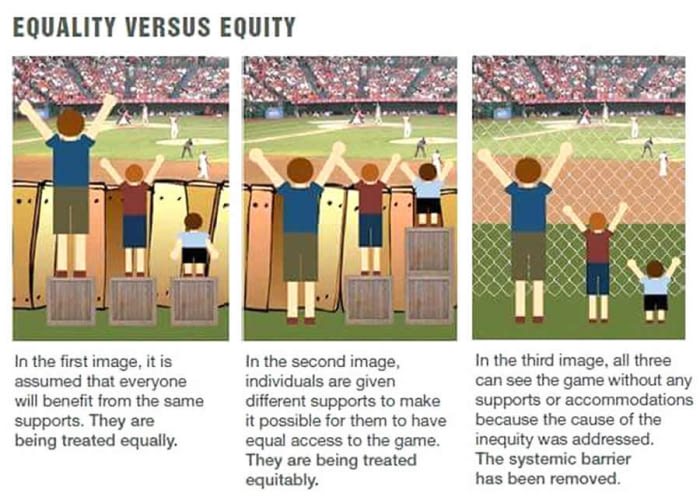
That's not a third option - it is the conservative option. If you build a fence that is tall such that some person is disadvantaged, then he doesn't really have the same rights.
The short person still has the right to look over the fence. They just have practical difficulties on exercising it.
Similar cases: Voter ID laws with disproportionate impact on minorities, gay people having "equal" right to marry someone of the opposite gender, people in impoverished school districts having "equal" rights to an education, etc.
Your last two examples are ones where a conservative ideologue would look and say "No, they aren't being granted equal rights". In the former, you have judges refusing to follow the law. In the latter, you have children who are not getting access to the same public education their peers in wealthier districts are.
>The short person still has the right to look over the fence. They just have practical difficulties on exercising it.
It all depends on what the fence is achieving. I can't take the cartoon literally, because conservatives wouldn't argue that people should have equal rights to view a ball game - whether you can view one or not has little bearing on, say, your financial success. Nor does it impinge on your right to speech, religion, etc. If the fence represented something that was a barrier to achieving what is viewed as a right, and it's a barrier for one group and not for another, then the approach in the cartoon is not inconsistent with conservative ideology.
With regards to voter ID laws: I'm not even going to go there, as in my past experience, it's an issue that both sides refuse to understand the counterpart's.
> Your last two examples are ones where a conservative ideologue would look and say "No, they aren't being granted equal rights".
Unless we're "no true Scotsman"ing things here, conservative ideologues in the US (and a variety of other countries) have strongly and consistently opposed gay marriage, often arguing they had the "same rights" as others and that allowing same-sex marriage would be "special treatment".
Before that, the same was true for conservatives and interracial marriage.
The point of the cartoon is not to advocate for the right to watch a baseball game. It's an analogy showing how the binary "you either have to have an unfair situation or give someone preferential treatment" isn't always the only two options.
>If his studies basically equated liberal ideology with communism (equal outcomes)
It's an easy mistake to make, but Communism (at least as Marx and his contemporaries and Lenin envisaged it) does not have anything to do with the principle of equal outcomes except in a very narrow sense - this sense being equality of privileges to some portion of society.
I think the bigger issue is that I've never anyone other than conservatives characterize liberals as believing in "equal outcomes". That's a slanted frame from the getgo.
Among democrats and liberals, it's usually "equal opportunity" or "equal starting lines", language like that. That's very different than "equal outcomes" because it still believes in self-reliance, merit, diversity in outcomes, etc - it's just that it requires a level of fairness that applies to everyone.
Not a lawyer, probably wrong, but: California's courts won't enforce a contract not recognized by California law, but the courts of other states will, and it will depend on whether the employer can get personal jurisdiction for the case in the right state.
The short answer is: in your situation, you'd need a lawyer.
(I think --- not sure, not an authority --- that the "incorporation in Delaware" part of this has minimal impact; your residence in North Carolina, and the firm's operations in California, are probably the big two salient facts).
I've never seen a contract that didn't stipulate the jurisdiction it would be enforced in. Maybe that doesn't matter, I know there's a lot of overreach in these things.