In my mind, their rightful place is transcription of written speech where the speaker pauses, and either inserts an island idea, or changes course. The comma doesn't suffice, because it's bridging an initial idea with expounding on the same idea. But so many times in written text I see it abused, lazily employed, because the author used a sentence fragment for effect, or wanted to amp up the pause and drama when a comma or, hell, even a semi-colon would have served the purpose better.
The advent of the generic AI writing style has had one good effect on my own work: making me take an unflinching look at my own laziness in writing. Now I tend to clean things up while at the same time try to inject some personality in order to NOT be dismissed as AI.
> the new "free" software is a sales funnel into the paid subscription, and will also increasingly have that "second-class" feeling as new pro-only things are added to it
There's a plague of this on the entire industry now. Free apps abound, none of them will do exactly what you need, all of them will point you to the shiny unfree thing that will.
The practice would be easier to tolerate if the unfree thing had reasonable pricing. Alas, it is always subscription-based and the monthly fee is crazy high, in the range of re-buying a traditional download product every four months. I understand that professional users might have more money to spend but it still seems to me that those companies overestimate what potential customers are willing to pay as running costs.
If you get value out of the free part of a tool, great! If not, then you get to choose to pay for the rest or not. Personally I'm happy that it tends to be the feature set I can live without that costs money. Not always, but often enough.
There is a big difference between a one time payment and a recurring payment, especially if the company canceling the product or going out of business means you can no longer use the tool, and I honestly steer clear of those in most cases.
Yes, that's the situation at launch. The fear that's expressed above is that the subscription model incentivizes pushing people towards it as hard as possible. It's the exact opposite of Serif's straightforward model from before. Get ready for most new features (including ones that are unrelated to AI) to become locked to the subscription model. When they think they're not getting enough out of Affinity, they may also start cutting core functionality to force people to subscribe. Maybe, a limit on how many documents you can edit at once, or a layer limit (for the photo part), or an object limit (for the vector/"designer" part). This is how all of these subscriptions go nowadays.
>You don’t have to keep paying for a subscription. You can stop at any time and still have access to all the non-AI features
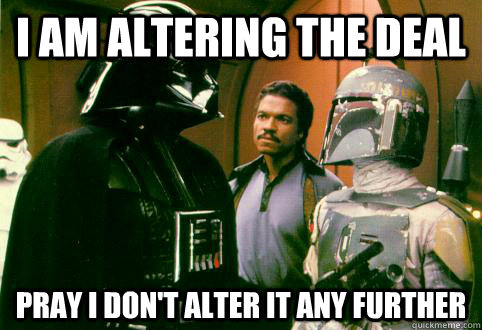
And if Canva decides that "I am altering the deal. Pray I don't alter it any further,"[0] what will you do then? Go and rent the Adobe subscription suite instead?
It's not even close. This is more akin to shareware where Bill Gates shows up at your house to collect a payment every month and formats your hard drive if you don't cough up the money.
Shareware gave you a perpetual license and control that couldn't be taken away, especially before the internet.
I like my W10 laptop more than I need Windows, so yet another machine and around here will join the dark side. that will make, let's see... seven machines at home that shipped with windows and now have some flavor of *nix.
This is really the perfect point in the timeline- "in these uncertain times-" to posit themselves as a working repository of credible information.
Also I firmly believe the Wikipedia app is key to their sustained relevance. Users get forwarded to the app from web browsers with wiki links, this gets people in the dedicated interface.
from a design standpoint there need to be more avenues on each page inviting people to browse and explore, spend more time there.
My current plan is moving to self-hosted photo and web (I'll be paying the ISP no matter what), embracing minimalism and the Fediverse for connecting with others. Open source software, hardware I control. Relationship between commercial entities and consumers is starting to feel like a war, and every consumer needs a bunker.
It also wouldn't be a terrible idea to convert a sunny room into a vertical hydroponic vegetable farm.
I don't know why you are getting down voted. As someone with a 2 year old and hoping for another one, I'm terrified of all the things you have to take into consideration that my parents didn't when choosing a school or area to live in.
Accelerating AI is going to require some overhead that walmart most likely is not anticipating. It seems like many companies weren't anticipating it, which you see when a company adopts AI, use it as an excuse to let people go, then re-hire them when it's clear AI needs human guidance. Walmart has done a lot in meatspace to pare logistics down to the minumum, but clearly under management that was more progressive than those in charge now who seem to be coasting on past achievements, enshittifying aspects of the business where they want to see more profits. I can only imagine this is going to be messy.
You are 100% correct that it has become increasingly politicized in recent days. My reaction is it should be non-controversial to approach self-improvement in an agnostic, purely therapeutic way.
It's a really fine line "holistic" practice in general has had to tread to not insult either the strictly religious, or the strictly irreligious. But it's potentially the sphere where this advice could come from. Do you have connections to a community? Do you take time for self-care? Have you taken a walk in nature lately? Do you try to do things mindfully? Have you tried taking stock at the end of the day with journaling in order to empty the mind of worry before sleep? this kind of advice is aimed at physical bases for positive effects on feelings of well-being we often lump into "spirituality" which are really more mind and body hacks than anything else.
I agree, all of the questions you pose would be fine by me and wouldn't immediately put me on the defensive.
Any variety of "what is your spiritual belief" would get me to clam up, though, for the reasons I said.
There's also another factor that, if the health care provider in front of me isn't someone I already know pretty well, I'd assume that they're asking as a prelude to some sort of effort to evangelize to me or condemn me because in any other setting, that question is almost always such a prelude. Rightly or wrongly, it would make me suspicious of and on guard with the health care provider.
It doesn't require any faith. That is the thing about science, with a few very basic steps, it proves itself. There is only knowledge and experience. These disenfranchised men need to get off the internet and out of their echo chambers and out in the world, challenge themselves to prove these things. Extrapolate their own conclusions.


The advent of the generic AI writing style has had one good effect on my own work: making me take an unflinching look at my own laziness in writing. Now I tend to clean things up while at the same time try to inject some personality in order to NOT be dismissed as AI.